책 소개About the Book
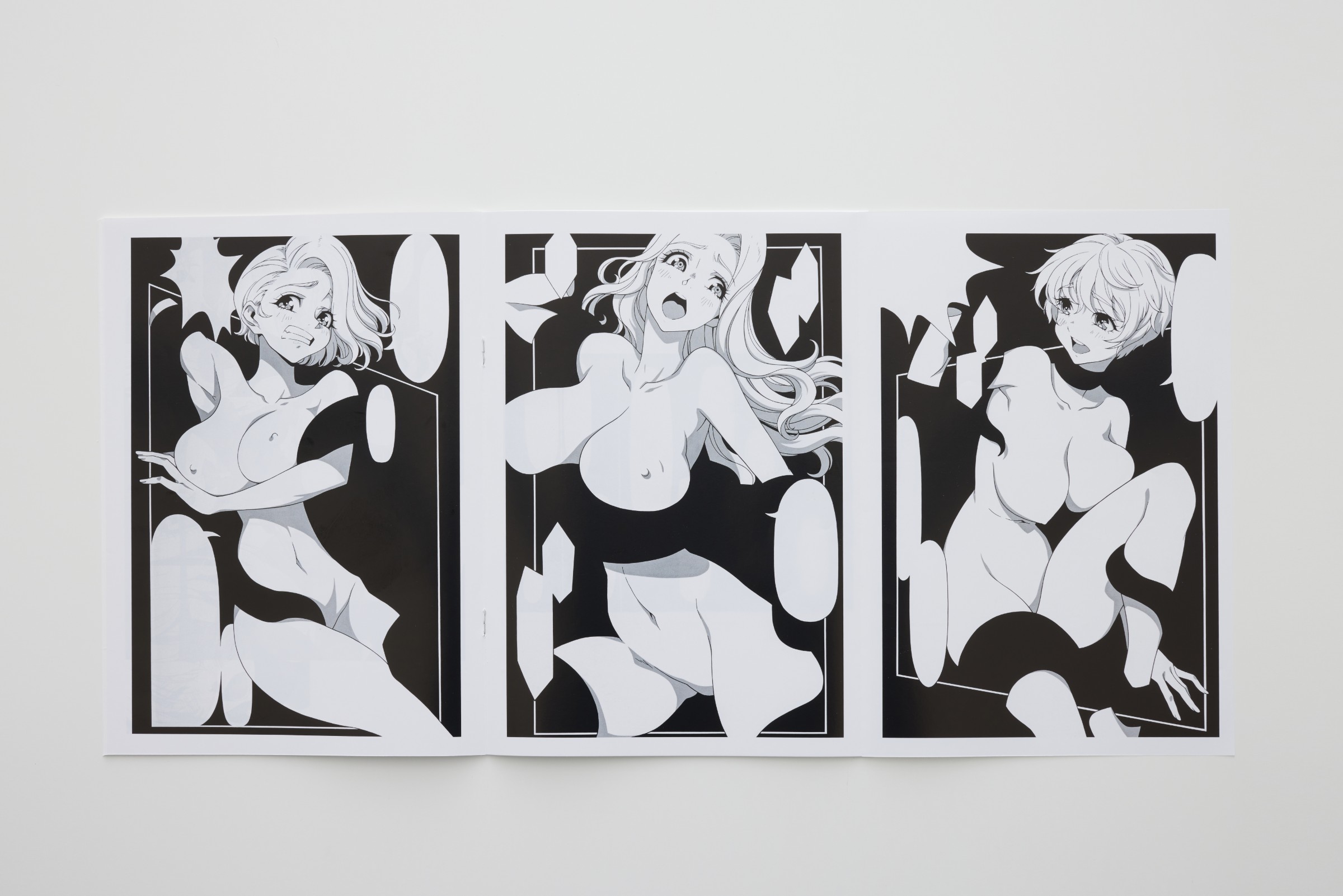
만화를 통해 동시대 시각 문화를 탐구하는 이윤성 작가의 개인전 《불완전한 Fragmentary》를 담은 도록이다. 작가는 신작 <라오콘 Laocoon> 연작 19점과 <십계 The Ten Commandments>에서 헬레니즘 조각 최고의 걸작으로 불리는 “라오콘(Laocoon)” 상을 회화로 재해석한다. 조각상의 유실된 조각들은 나눠진 캔버스로, 남성은 여성으로, 뱀은 검은색 배경으로 바뀌며 고전의 이미지를 불완전한 형태로 다시 구성한다.
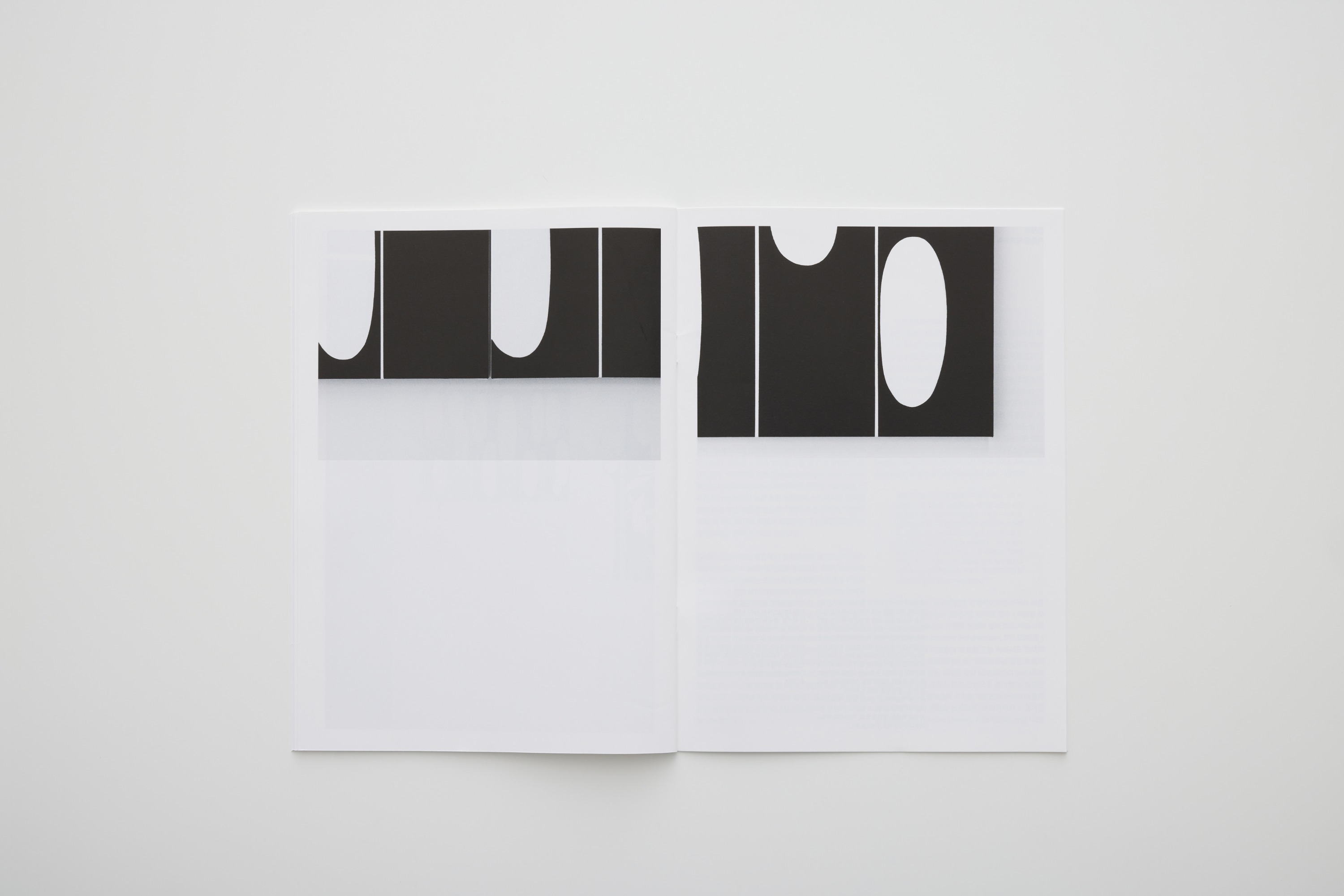
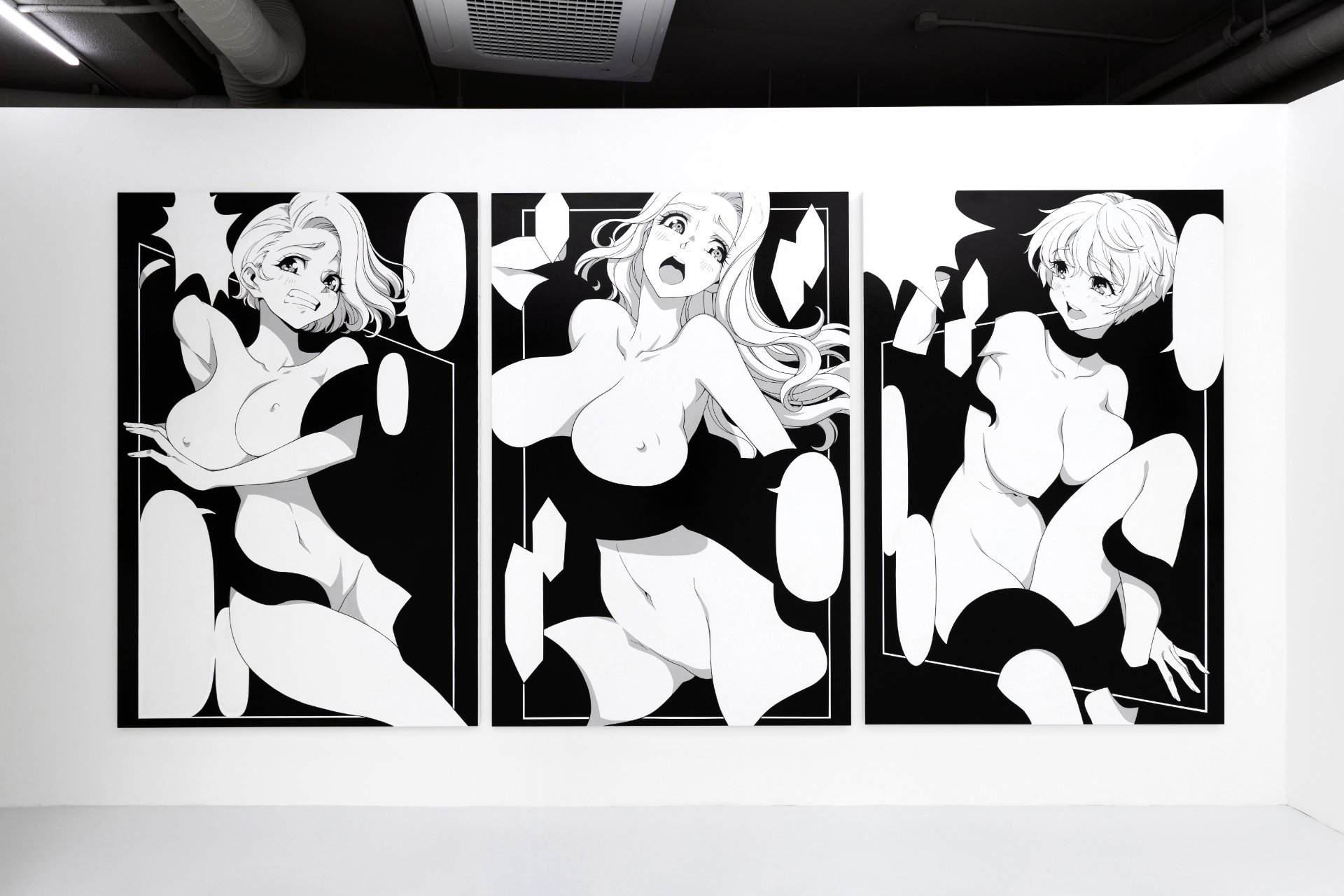
검은색 공간에 놓인 인물과 만화의 말풍선, 페이지를 나누는 선과 칸은 흰색 물감으로 재현된다. 말풍선 속 문자는 사라지고 만화 기호들은 회화 속 형태이자 사물이 되어 캐릭터를 앞에서 가리거나 뒤로 숨으며 공간감을 만든다. 세 명의 라오콘에 따라 나눠진 세 개의 패널과 여기서 파생된 얼굴들을 조합하고, 인물까지 모두 비워진 <십계>를 따로 배치해 만화와 회화의 형식을 탐구한다.
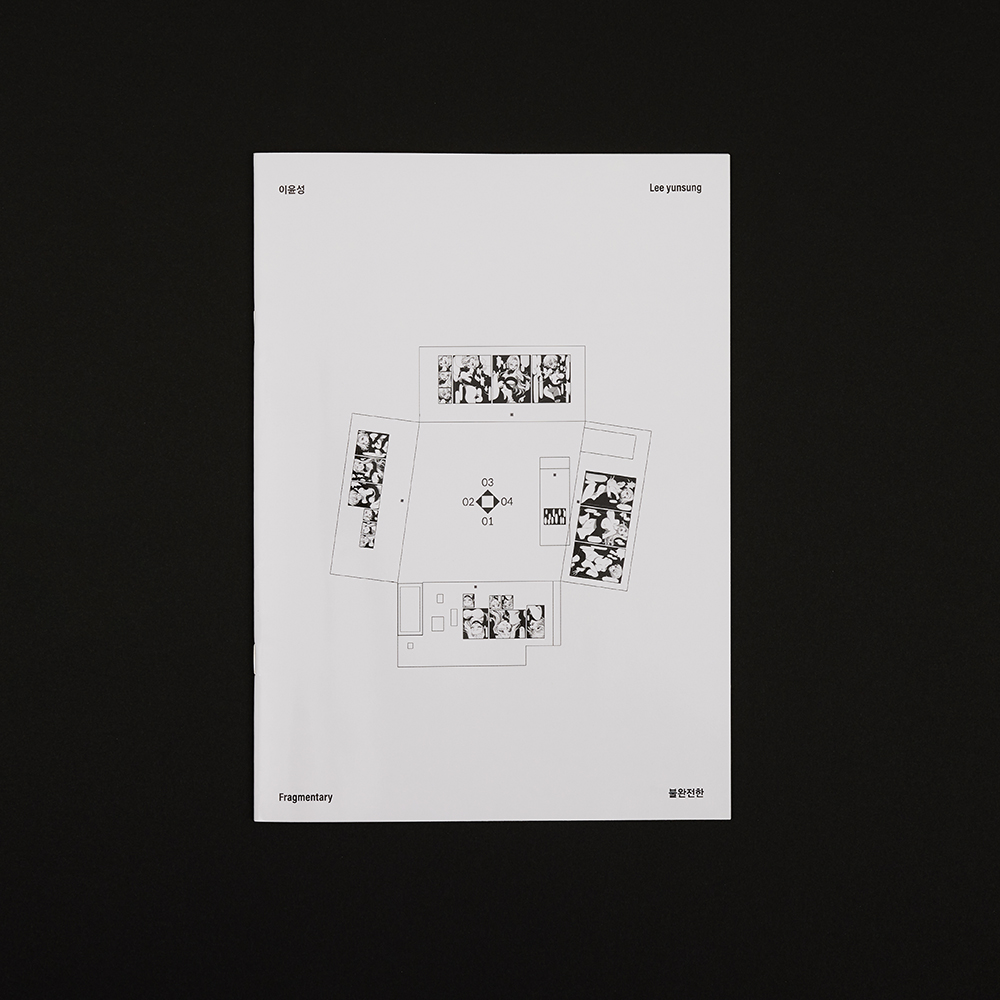
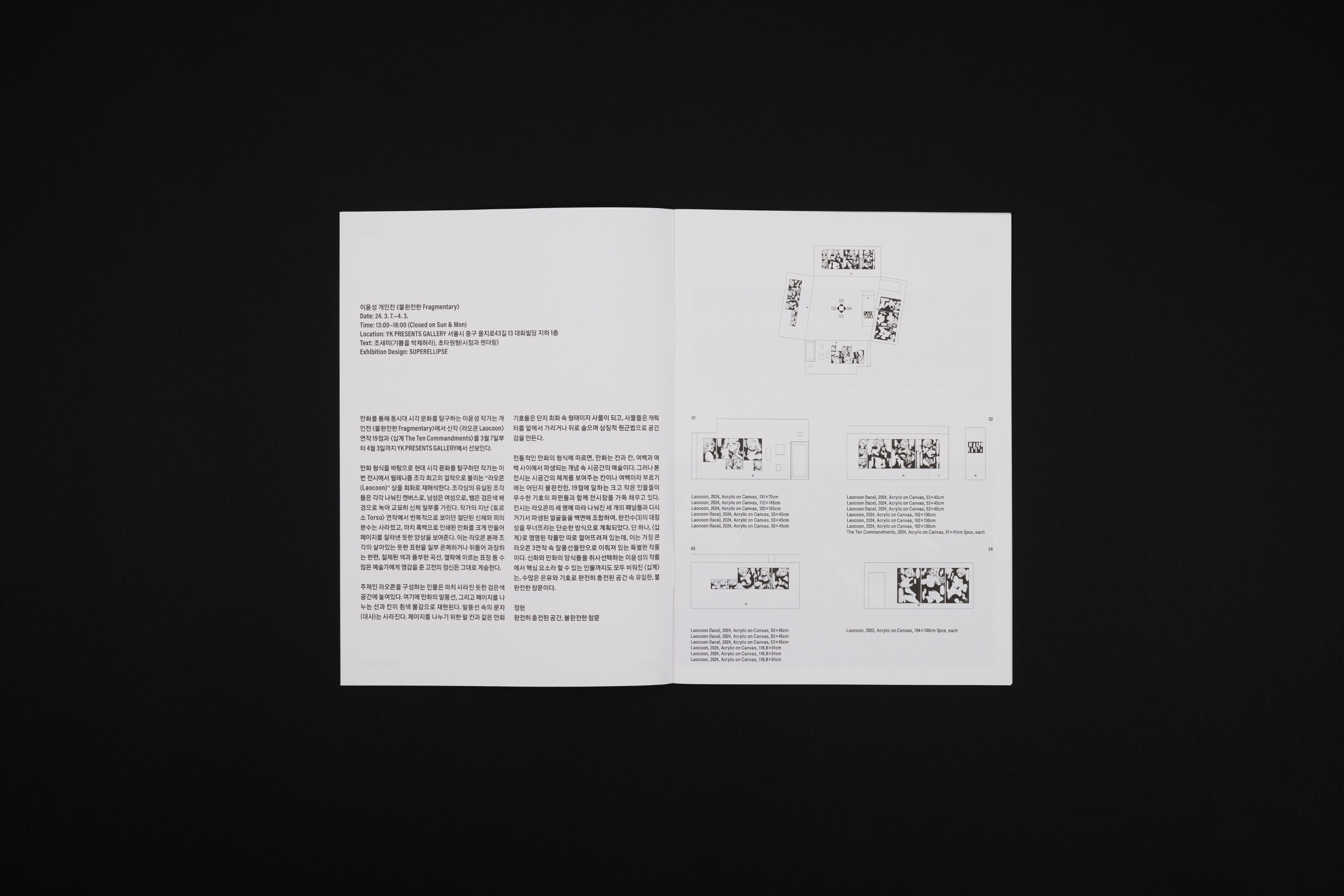
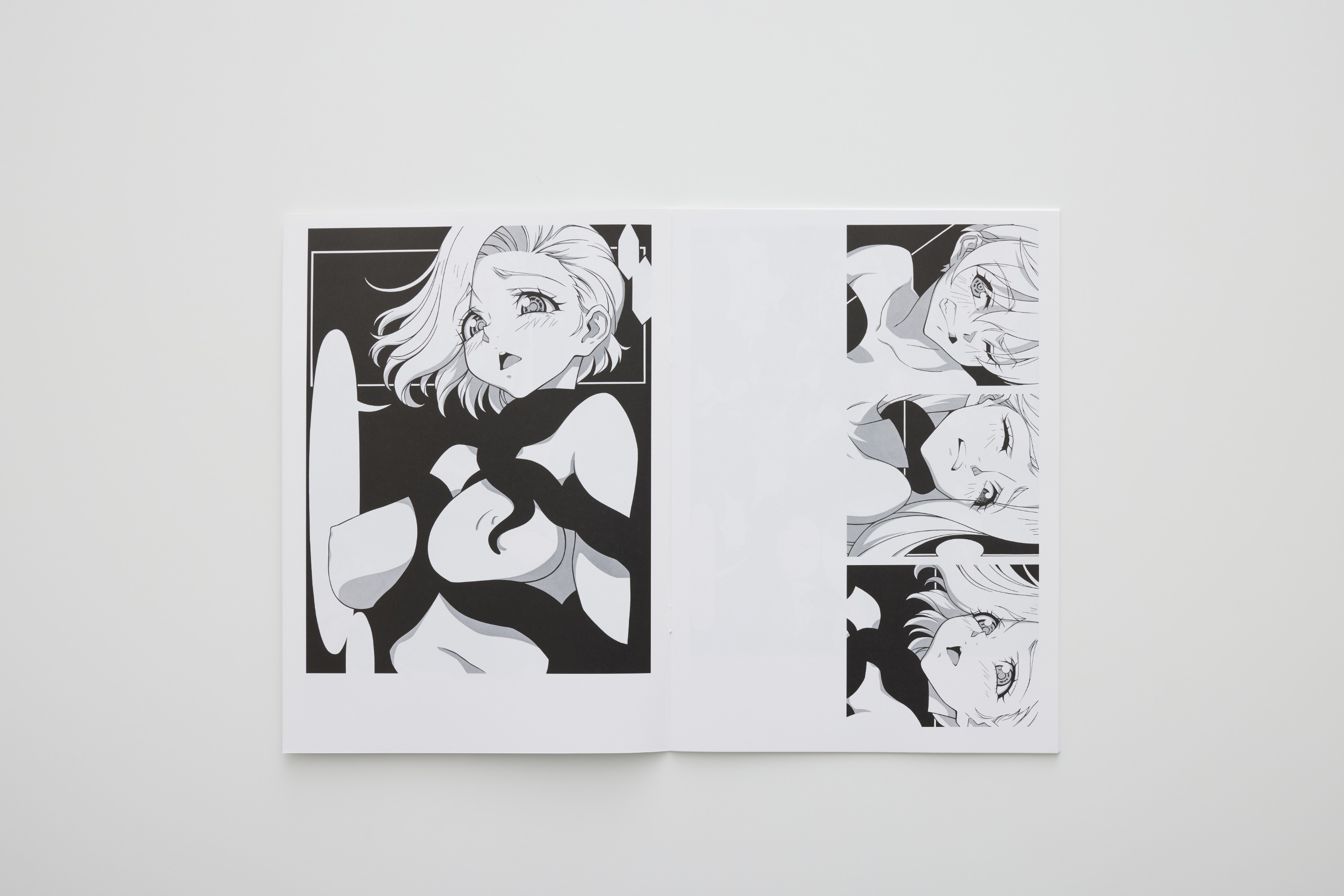
동 제목으로 출판된 전시 도록에는 김명찬의 사진, 안종민의 타입 운용, 초타원형의 렌더링이 더해졌다. 흑백의 1도 인쇄, 유광의 표지, 칸 처리된 이미지와 글씨, 접이식 브로마이드화 된 연작 등 만화의 다양한 특징을 연상시키도록 제작했다. 전시의 기록을 실제 작업과 같은 형식으로 반복하며, 3차원의 전시를 2차원에 압축하고 분해·해체하는 만화적 구성의 확장을 보여준다.
The catalogue of Lee Yunsung's solo exhibition Fragmentary, in which the artist explores contemporary visual culture through comics. In nineteen new works from the Laocoon series and in The Ten Commandments, he reinterprets in paint the Laocoon group, often called the greatest masterpiece of Hellenistic sculpture. The statue's lost fragments become divided canvases, the men become women, and the serpents become the black ground, reassembling a classical image in fragmentary form.
Figures set in black space, speech balloons, and the lines and panels that divide a comics page are all rendered in white paint. The words inside the balloons have disappeared; the signs of comics become forms and objects within the painting, covering the characters from the front or slipping behind them to create a sense of space. Three panels divided along the three Laocoon figures are combined with the faces derived from them, while The Ten Commandments, emptied even of figures, is placed apart, exploring the forms of both comics and painting.
The catalogue, published under the same title, adds photography by Myungchan Kim, typography by Jongmin Ahn, and renderings by Superellipse. One-color black printing, a glossy cover, images and text set in panels, and the series reproduced as a fold-out poster all recall the conventions of comics. By repeating the record of the exhibition in the same form as the work itself, the book compresses a three-dimensional exhibition into two dimensions, taking it apart and extending the comic-book structure.
목차Contents
1. 완전히 충전된 공간, 불완전한 창문
2. 시점과 렌더링
3. 전시전경
4. 작품
5. 기쁨을 박제하라
1. A Fully Charged Space, a Fragmentary Window
2. Viewpoint and Rendering
3. Installation Views
4. Works
5. Taxidermy the Joy
품목정보Product Details
| 발행일Publication Date | 2024-10-01 |
|---|---|
| 쪽수Pages | 45쪽45 pages |
| 무게Weight | 86g |
| 크기Dimensions | 188 x 262 mm |
| ISBN13ISBN-13 | 9791197318948 |

원작Original Work
Laocoon
〈라오콘〉은 바다뱀에게 감겨 죽어 가는 트로이 신관과 두 아들의 고대 조각을 흑백 회화로 다시 그린 연작이다. 세 인물은 여성이 되었고, 뱀은 검은 배경에 묻혔으며, 그들이 내지르는 비명은 빈 말풍선으로 남았다.
라오콘은 그리스군이 남긴 목마를 성안에 들이지 말라고 경고했다가, 신의 분노를 사 두 아들과 함께 바다뱀에게 죽는다. 로마 시인 베르길리우스는 그가 하늘을 향해 소리쳤고, 그 소리가 제단에서 도망치는 상처 입은 황소의 울부짖음 같았다고 썼다. 조각은 그 순간을 붙잡았지만 목소리까지 담지는 못했다. 대리석은 입을 벌린 채 영원히 침묵한다.
이 주제는 2010년에 디지털로 한 번 그린 적이 있다. 다시 그리는 동안 이미지가 달라졌고, 처음보다 다양한 의미와 형식을 담을 수 있었다. 작업을 하며 흑백 이미지에 흥미를 느꼈고, 그렇게 흑백 연작이 되었다.
이 연작은 조각의 침묵을 만화와 애니메이션의 양식으로 다시 그린다. 그 양식은 기술적 한계에서 나왔다. 주간지의 값싼 인쇄 때문에 만화는 흑백의 선과 스크린톤으로 그려졌다. 매주 방영해야 했던 셀 애니메이션은 한 색과 그보다 어두운 한 색, 두 가지 톤으로 양감을 냈고, 정지 화면과 효과선으로 장면을 끌고 갔다. 나는 그 한계를 회화의 조건으로 삼았다. 색을 없애고, 뱀과 배경을 같은 검정으로 칠했다. 뱀은 몸에 닿는 자리에서만 형태가 드러나고, 뱀에 가려 조각난 몸은 토르소 연작의 연장선에 놓인다.
빈 말풍선은 토가시 요시히로의 만화 〈헌터×헌터〉(1998~)에서 대화만으로 연출된 장면을 떠올리며 시작된 아이디어다. 처음에는 말로 가득 찬 화면을 생각했지만, 말을 고르기보다 비워 두는 쪽이 더 많은 것을 말했다. 절규하는 라오콘 곁에는 빈 말풍선만 되풀이된다. 흰 말풍선의 꼬리는 검은 뱀의 꼬리를 닮았다. 말 또한 뱀처럼 몸을 휘감는다.
라오콘 군상은 비극을 새긴 조각이지만, 그 몸은 비극만으로는 설명되지 않을 만큼 아름답다. 로마의 플리니우스는 이 조각을 어떤 회화나 청동상보다 뛰어난 작품이라 불렀다. 당대 사람들이 감탄한 것은 교훈이 아니라 몸을 빚어낸 솜씨였을지 모른다. 18세기의 레싱은 조각가가 비명을 한숨으로 누그러뜨렸다고 보았다. 고통의 한가운데서도 아름다움을 놓지 않았다는 것이다. 주제와 형상 사이의 이 어긋남은 오랫동안 '고귀한 고통'이라는 이름 아래 가려져 왔다.
나는 세 인물을 여성으로 바꾸어 익숙한 시선을 비틀어 본다. 얼굴에는 뺨을 가로지르는 빗금과 물기 어린 커다란 눈처럼, 만화에서만 가능한 과장된 표현들을 빌렸다. 조각이 이미 품고 있던 아름다움 위에 또 하나의 양식이 겹쳐지면서, 비극 아래 가라앉아 있던 황홀의 기색이 조용히 떠오른다. 그것은 새로 더해졌다기보다, 처음부터 그 조각을 만든 손에 깃들어 있던 시선에 가깝다.
전시 제목 《불완전한 Fragmentary》(YK Presents, 서울, 2024)는 조각의 파편이라는 뜻이면서, 아직 완성되지 않은 상태를 가리킨다. 모든 것이 갖춰지지 않은 한계 속에서, 때로 더 나은 것이 발견된다. 전시에서는 〈Laocoon〉(2024, 캔버스에 아크릴, 3폭, 각 194×130cm)을 중심으로 같은 제목의 작품들을 함께 걸었다. 162×130cm 세 점, 131×70cm·112×145cm·120×100cm 각 한 점, 53×45cm 아홉 점이다.
전시장 기둥에는 〈The Ten Commandments〉(2024, 캔버스에 아크릴, 2폭, 각 61×41cm)를 걸었다. 모세가 받은 두 돌판의 모양을 따 두 개의 캔버스를 만들고, 그 안에 빈 말풍선 열 개를 그렸다. 신의 말이 새겨져야 할 돌판에는 아무 말도 없다. 신을 향해 들리지 않는 비명을 지르는 라오콘, 그리고 말이 비워진 십계. 둘은 불완전한 진공으로 남는다.
Laocoon is a series of black-and-white paintings that revisits the ancient sculpture of the Trojan priest and his two sons dying in the coils of sea serpents. The three figures have become women, the serpents have sunk into the black ground, and their screams remain as empty speech balloons.
Laocoon warned the Trojans not to bring the wooden horse left by the Greeks inside their walls, and for this he drew the wrath of the gods and was killed by sea serpents together with his two sons. The Roman poet Virgil wrote that he raised his cries to the heavens, like the bellowing of a wounded bull fleeing the altar. The sculpture seized that moment, but it could not hold the voice. The marble opens its mouth in eternal silence.
I first painted this subject digitally in 2010. In painting it again, the image changed and came to hold a wider range of meanings and forms than before. Along the way I found myself drawn to black-and-white imagery, and so it became a black-and-white series.
The series repaints the sculpture's silence in the visual language of manga and animation, a language born of technical limitations. Because weekly magazines were cheaply printed, manga was drawn in black line and screentone. Cel animation, which had to air every week, built volume from just two tones, a base color and a single darker shade, and carried its scenes with held frames and effect lines. I took those limitations as the conditions of painting. I removed color and painted the serpents and the background in the same black. The serpents take shape only where they touch the bodies, and the bodies, broken into fragments where the serpents cover them, extend the line of the Torso series.
The empty speech balloons began with a memory of scenes in Yoshihiro Togashi's manga Hunter × Hunter (1998–) staged through dialogue alone. At first I imagined a picture crowded with words, but leaving the balloons empty said more than any words I could choose. Beside the screaming Laocoon, only empty balloons repeat. The tails of the white balloons resemble the tails of the black serpents. Words, too, coil around the body like snakes.
The Laocoon group is a sculpture of tragedy, yet its bodies are too beautiful to be explained by tragedy alone. The Roman writer Pliny the Elder called it a work superior to any painting or bronze. What ancient viewers admired may have been less a moral lesson than the skill that shaped the bodies. In the eighteenth century, Lessing argued that the sculptor had softened the scream into a sigh, refusing to let go of beauty even at the height of suffering. This gap between subject and form has long been veiled by the idea of noble suffering.
I turn the three figures into women to unsettle a familiar way of looking. For their faces I borrowed the exaggerations only manga allows, such as hatched lines across the cheeks and large, glistening eyes. As another style is laid over the beauty the sculpture already held, a trace of rapture that had sunk beneath the tragedy quietly rises to the surface. It is less an addition than a gaze that had lived, from the start, in the hands that made the sculpture.
The exhibition title, Fragmentary (YK Presents, Seoul, 2024), whose Korean title Bulwanjeonhan means "incomplete," refers both to the fragments of a sculpture and to a state not yet complete. Within limits, where not everything is in place, something better is sometimes found. The exhibition centered on Laocoon (2024, acrylic on canvas, 3 panels, 194 × 130 cm each), shown together with works of the same title: three at 162 × 130 cm, one each at 131 × 70 cm, 112 × 145 cm and 120 × 100 cm, and nine at 53 × 45 cm.
On a column in the gallery hung The Ten Commandments (2024, acrylic on canvas, diptych, each 61 × 41 cm). Its two canvases take the shape of the two stone tablets Moses received, and on them are painted ten empty speech balloons. The tablets, which should bear the word of God, say nothing. Laocoon, screaming unheard toward the gods, and the commandments, emptied of words: both are left as fragmentary voids.