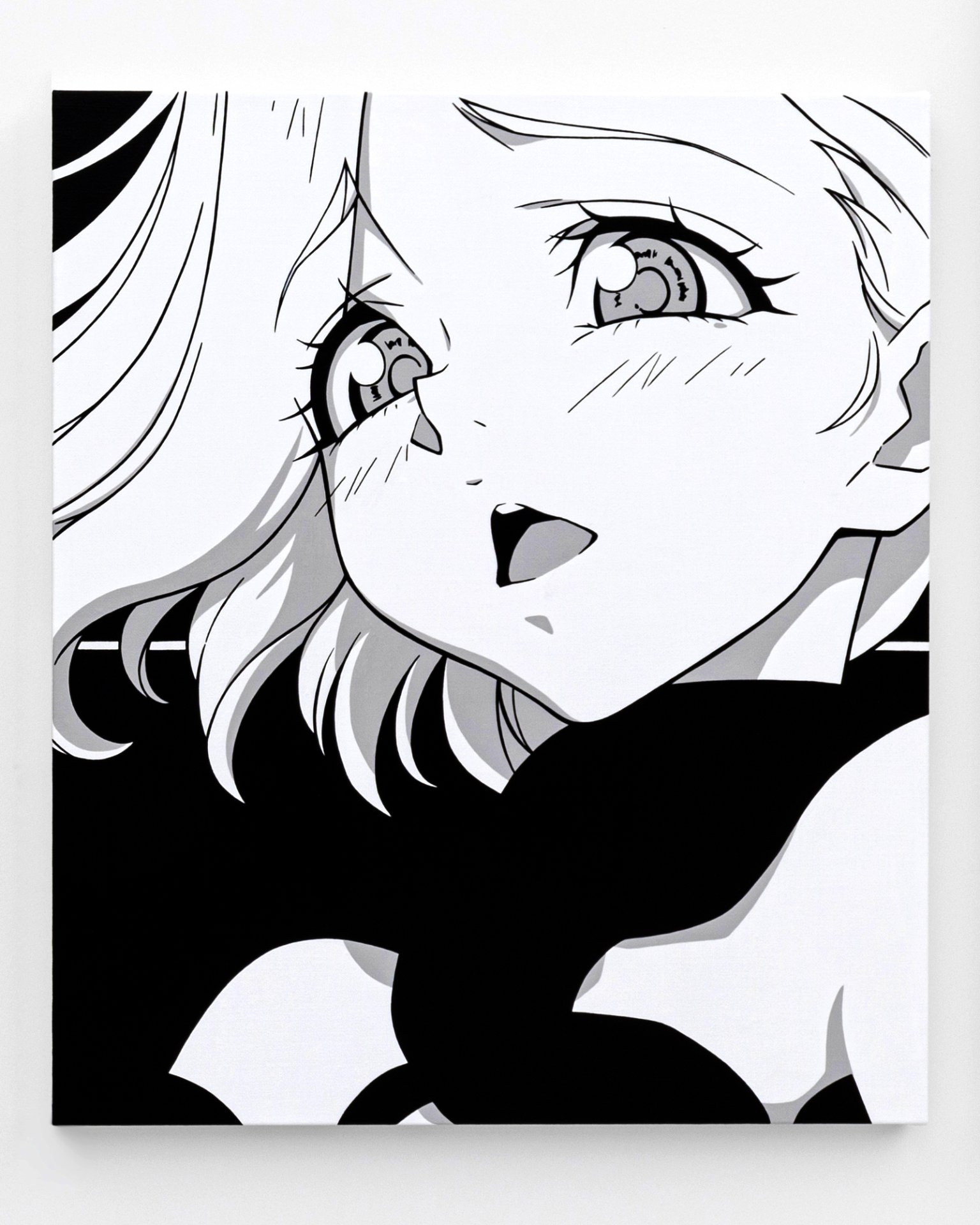
Laocoon (face)
53 × 45 cm
Acrylic on canvas
Unique work
$1,500
Laocoon (face) (2024) is a painting first shown in the solo exhibition Fragmentary (YK Presents, Seoul, 2024). It belongs to a series of black-and-white paintings that revisits the ancient sculpture of the Trojan priest and his two sons dying in the coils of sea serpents. Redrawn as women in black and white, the figures are fragmented by serpents hidden in the black ground, while lines cutting across the picture amplify their emotion.

53 cm
45 cm
53 × 45 cm
Acrylic on canvas
Unique work
Original Work
Laocoon
Laocoon (face), 2024, Acrylic on canvas, 53 × 45 cm
Laocoon is a series of black-and-white paintings that revisits the ancient sculpture of the Trojan priest and his two sons dying in the coils of sea serpents. The three figures have become women, the serpents have sunk into the black ground, and their screams remain as empty speech balloons.
Laocoon warned the Trojans not to bring the wooden horse left by the Greeks inside their walls, and for this he drew the wrath of the gods and was killed by sea serpents together with his two sons. The Roman poet Virgil wrote that he raised his cries to the heavens, like the bellowing of a wounded bull fleeing the altar. The sculpture seized that moment, but it could not hold the voice. The marble opens its mouth in eternal silence.
I first painted this subject digitally in 2010. In painting it again, the image changed and came to hold a wider range of meanings and forms than before. Along the way I found myself drawn to black-and-white imagery, and so it became a black-and-white series.
The series repaints the sculpture's silence in the visual language of manga and animation, a language born of technical limitations. Because weekly magazines were cheaply printed, manga was drawn in black line and screentone. Cel animation, which had to air every week, built volume from just two tones, a base color and a single darker shade, and carried its scenes with held frames and effect lines. I took those limitations as the conditions of painting. I removed color and painted the serpents and the background in the same black. The serpents take shape only where they touch the bodies, and the bodies, broken into fragments where the serpents cover them, extend the line of the Torso series.
The empty speech balloons began with a memory of scenes in Yoshihiro Togashi's manga Hunter × Hunter (1998–) staged through dialogue alone. At first I imagined a picture crowded with words, but leaving the balloons empty said more than any words I could choose. Beside the screaming Laocoon, only empty balloons repeat. The tails of the white balloons resemble the tails of the black serpents. Words, too, coil around the body like snakes.
The Laocoon group is a sculpture of tragedy, yet its bodies are too beautiful to be explained by tragedy alone. The Roman writer Pliny the Elder called it a work superior to any painting or bronze. What ancient viewers admired may have been less a moral lesson than the skill that shaped the bodies. In the eighteenth century, Lessing argued that the sculptor had softened the scream into a sigh, refusing to let go of beauty even at the height of suffering. This gap between subject and form has long been veiled by the idea of noble suffering.
I turn the three figures into women to unsettle a familiar way of looking. For their faces I borrowed the exaggerations only manga allows, such as hatched lines across the cheeks and large, glistening eyes. As another style is laid over the beauty the sculpture already held, a trace of rapture that had sunk beneath the tragedy quietly rises to the surface. It is less an addition than a gaze that had lived, from the start, in the hands that made the sculpture.
The exhibition title, Fragmentary (YK Presents, Seoul, 2024), whose Korean title Bulwanjeonhan means "incomplete," refers both to the fragments of a sculpture and to a state not yet complete. Within limits, where not everything is in place, something better is sometimes found. The exhibition centered on Laocoon (2024, acrylic on canvas, 3 panels, 194 × 130 cm each), shown together with works of the same title: three at 162 × 130 cm, one each at 131 × 70 cm, 112 × 145 cm and 120 × 100 cm, and nine at 53 × 45 cm.
On a column in the gallery hung The Ten Commandments (2024, acrylic on canvas, diptych, each 61 × 41 cm). Its two canvases take the shape of the two stone tablets Moses received, and on them are painted ten empty speech balloons. The tablets, which should bear the word of God, say nothing. Laocoon, screaming unheard toward the gods, and the commandments, emptied of words: both are left as fragmentary voids.
View work →