About the Book
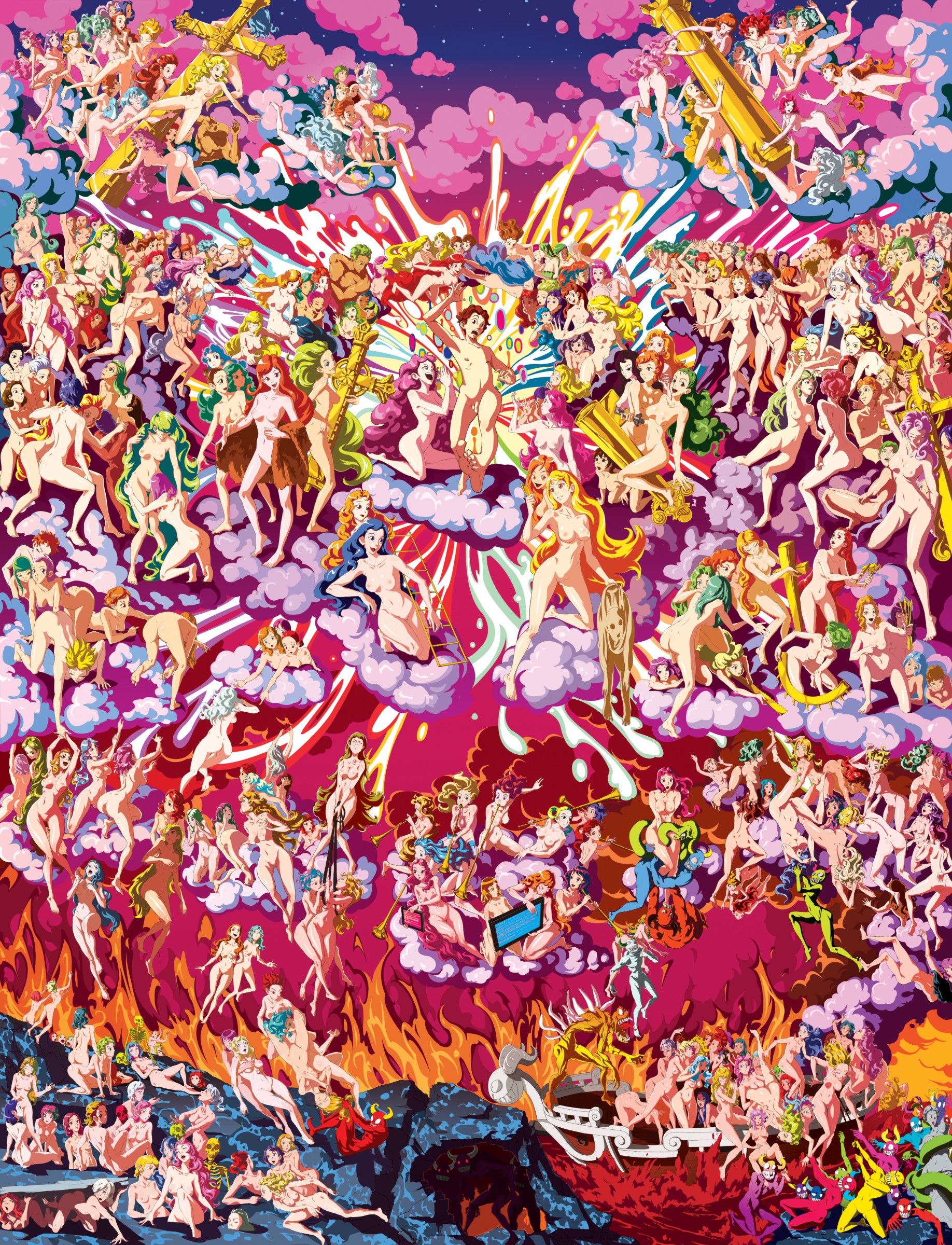
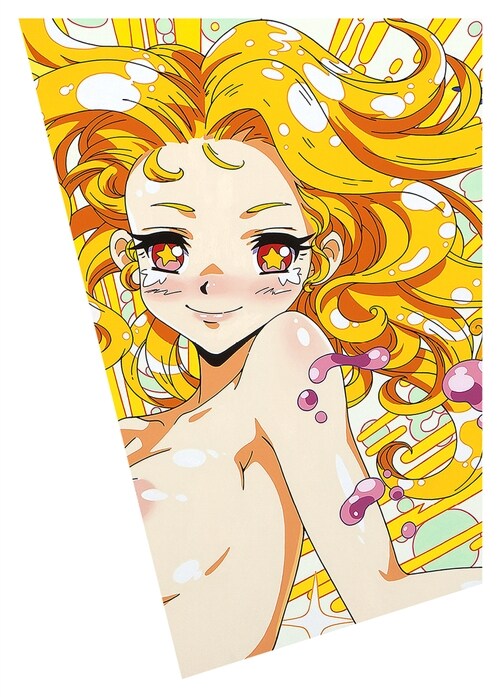
The catalogue of Yunsung Lee's solo exhibition Fragmentary, in which the artist explores contemporary visual culture through comics. In nineteen new works from the Laocoon series and in The Ten Commandments, he reinterprets in paint the Laocoon group, often called the greatest masterpiece of Hellenistic sculpture. The statue's lost fragments become divided canvases, the men become women, and the serpents become the black ground, reassembling a classical image in fragmentary form.
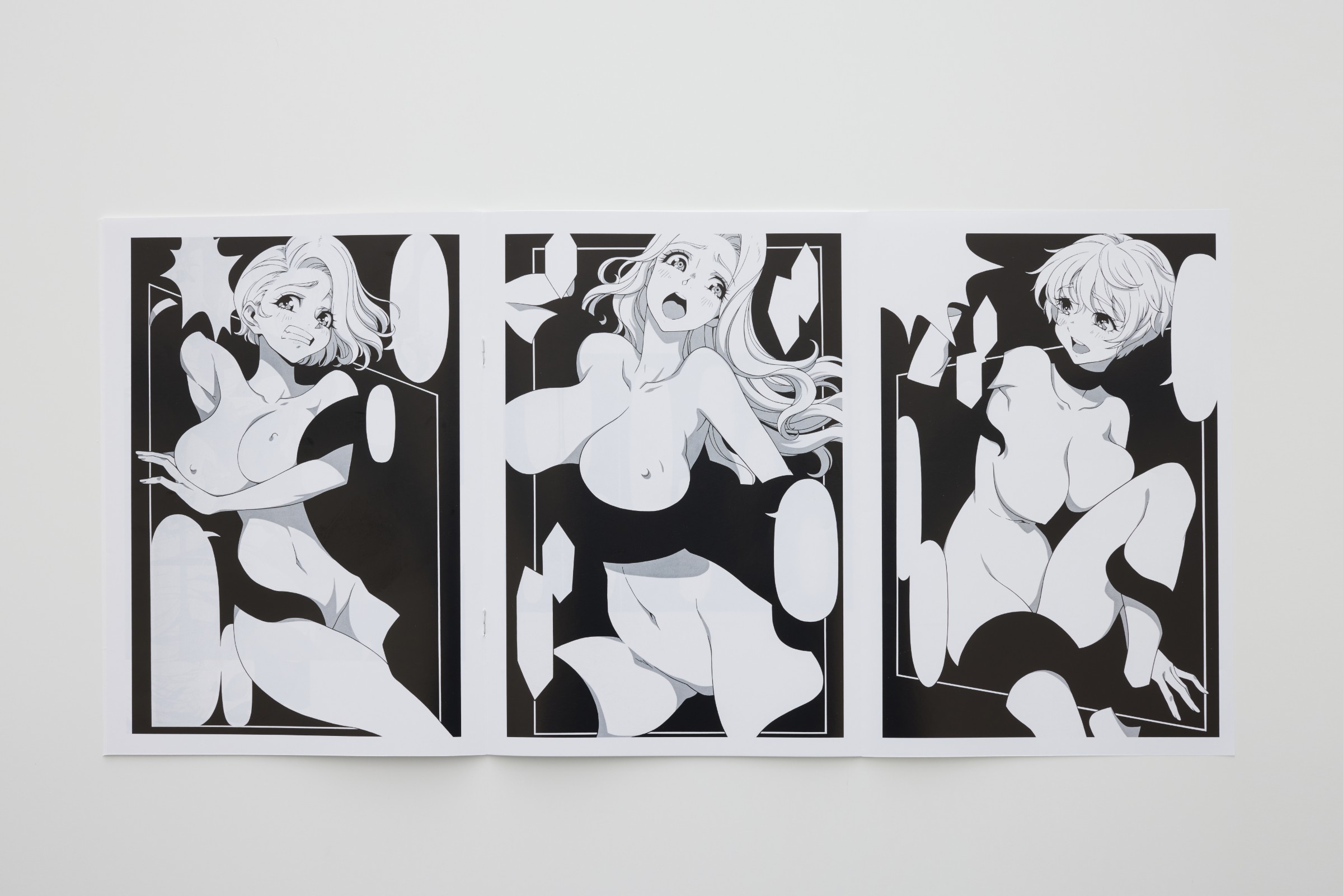
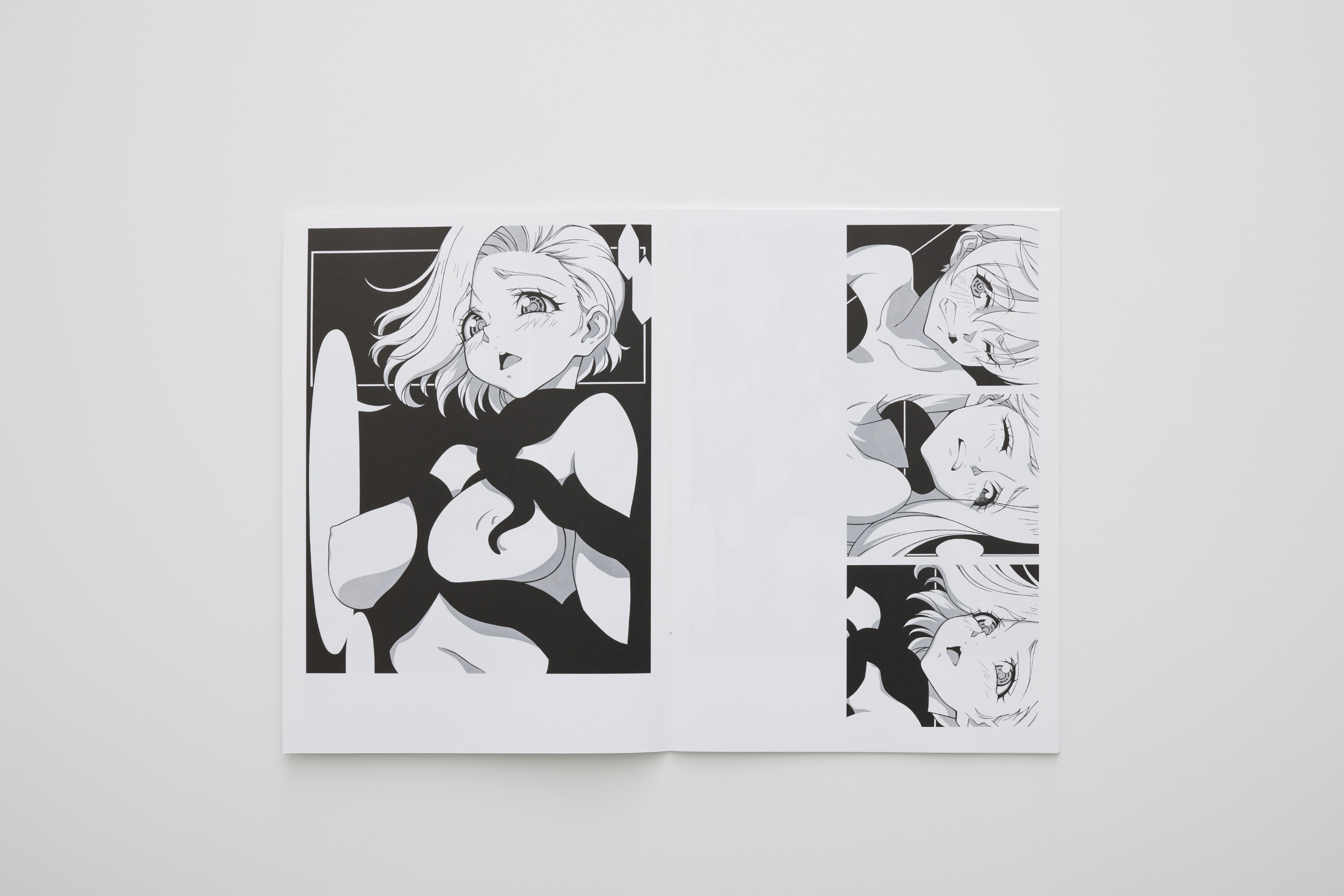
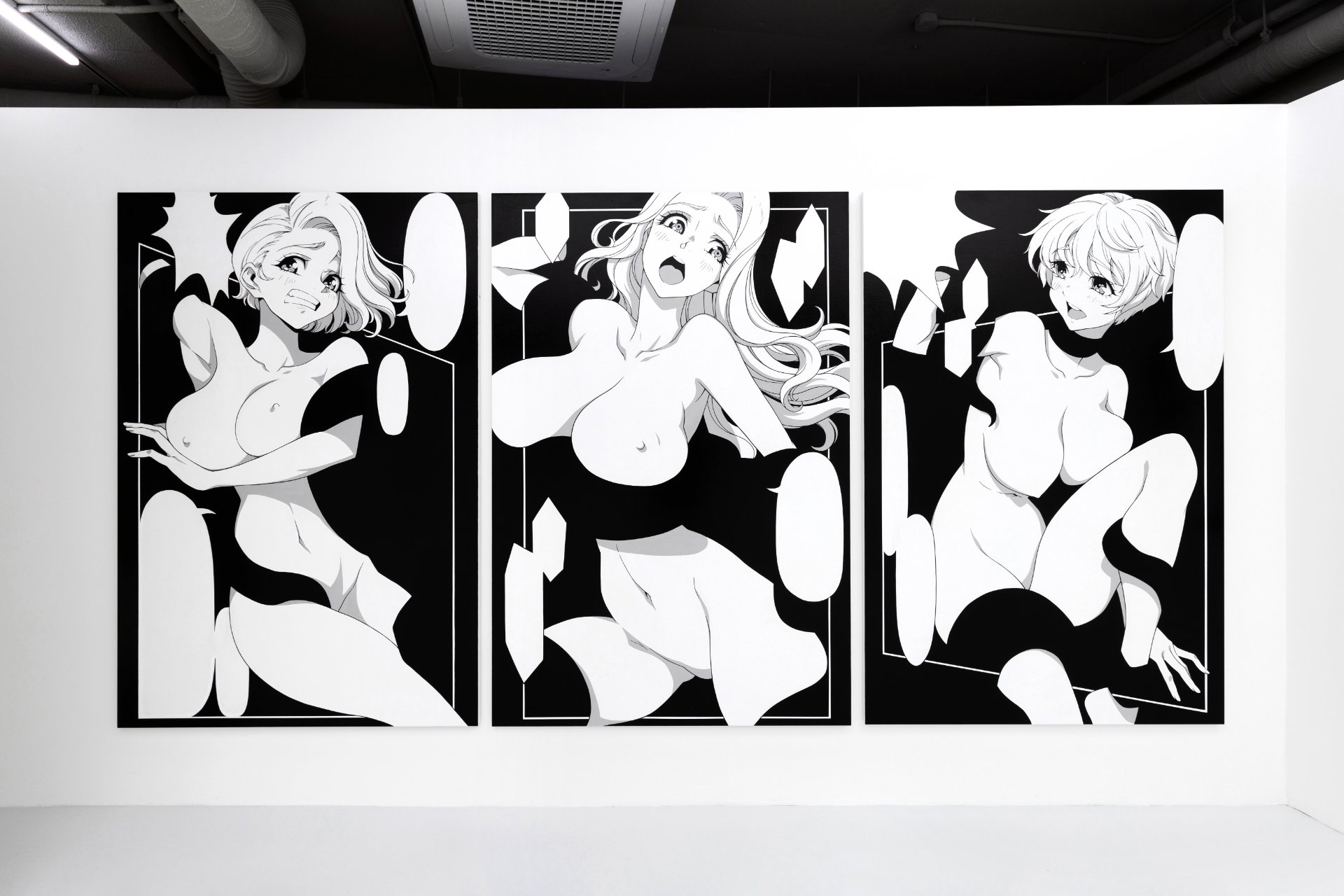
Figures set in black space, speech balloons, and the lines and panels that divide a comics page are all rendered in white paint. The words inside the balloons have disappeared; the signs of comics become forms and objects within the painting, covering the characters from the front or slipping behind them to create a sense of space. Three panels divided along the three Laocoon figures are combined with the faces derived from them, while The Ten Commandments, emptied even of figures, is placed apart, exploring the forms of both comics and painting.
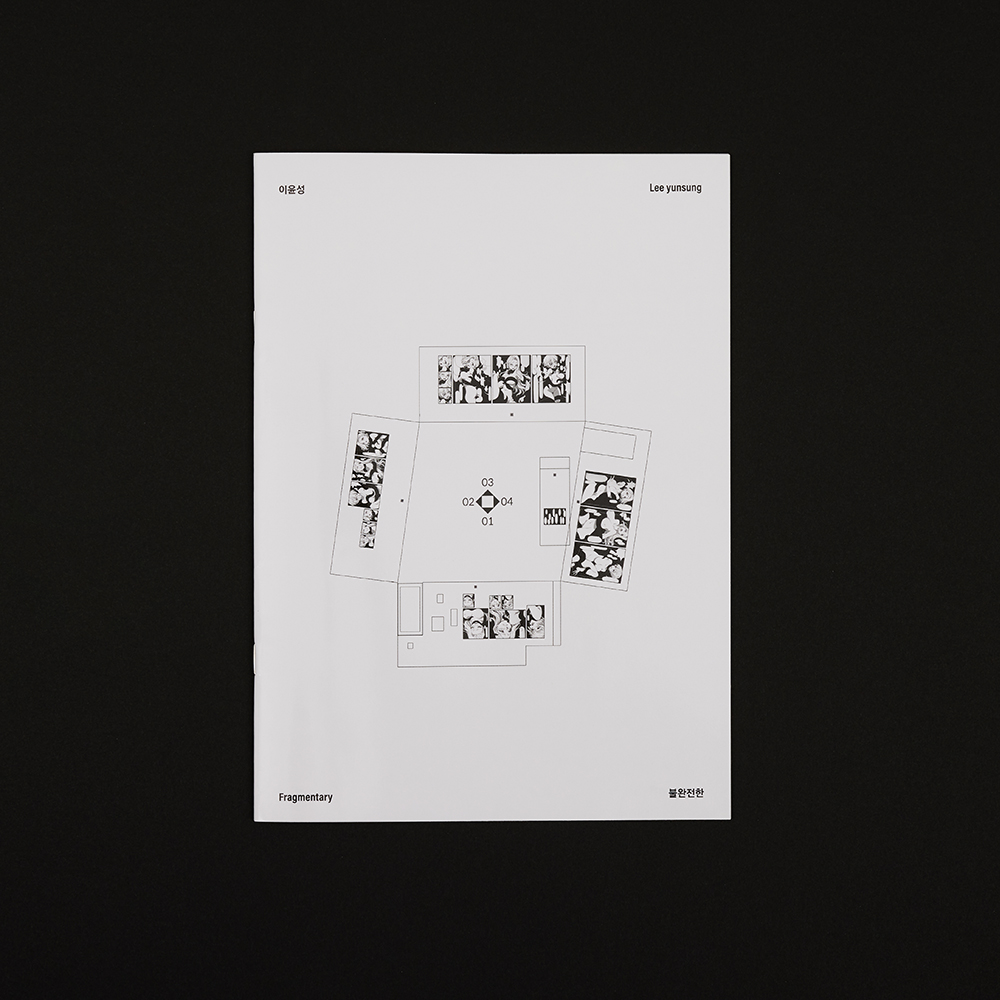
The catalogue, published under the same title, adds photography by Myungchan Kim, typography by Jongmin Ahn, and renderings by Superellipse. One-color black printing, a glossy cover, images and text set in panels, and the series reproduced as a fold-out poster all recall the conventions of comics. By repeating the record of the exhibition in the same form as the work itself, the book compresses a three-dimensional exhibition into two dimensions, taking it apart and extending the comic-book structure.
Contents
1. 완전히 충전된 공간, 불완전한 창문
2. 시점과 렌더링
3. 전시전경
4. 작품
5. 기쁨을 박제하라
1. A Fully Charged Space, a Fragmentary Window
2. Viewpoint and Rendering
3. Installation Views
4. Works
5. Taxidermy the Joy
Product Details
| Publication Date | 2026-09-30 |
|---|---|
| Pages | 45 pages |
| Weight | 86 g |
| Dimensions | 188 x 262 mm |
| ISBN-13 | 9791197318948 |

Original Work
Laocoon
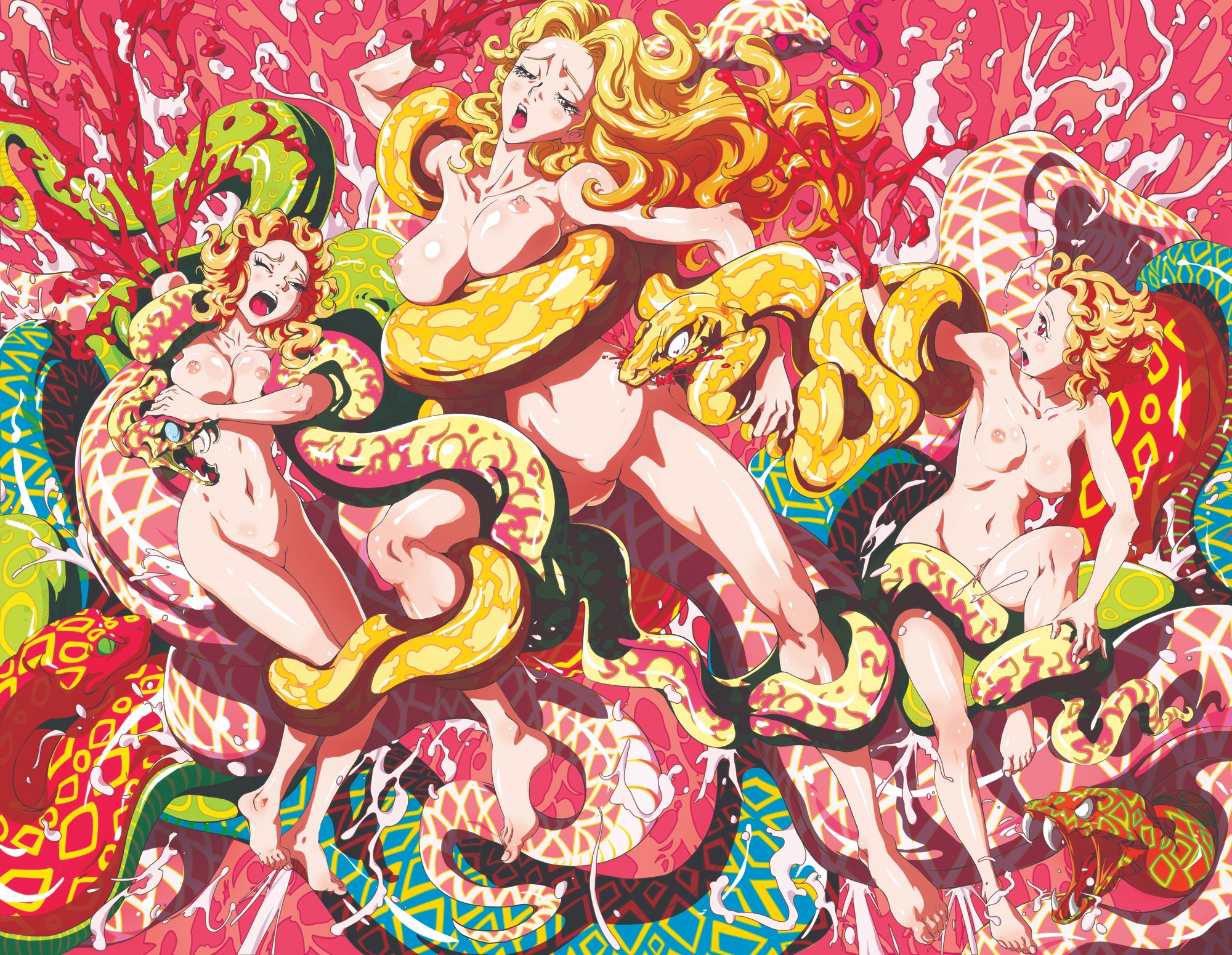
Laocoon is a series that repaints, in black and white, the ancient sculpture of the Trojan priest and his two sons dying in the coils of sea serpents. The three figures are changed to women, the serpents disappear into the black background, and the sound is painted as empty speech balloons.
Laocoon was a priest of Troy who warned against bringing in the wooden horse the Greeks had left behind, and for that he incurred the wrath of the gods and was killed by sea serpents together with his two sons. Virgil wrote that he cried out to the heavens, and that the cry was like the bellowing of a wounded bull fleeing the altar. The sculpture seized that moment but could not keep the sound.
I had painted Laocoon once digitally in 2010. The work and its title have a certain intensity, and I wanted to paint it again; as I went on, I judged that a black-and-white drawing was better, and it became a black-and-white series. Repainting an image from one's own past matters more than one might think. You can find how your thinking has changed, and look more deeply into what you were thinking then. The reason I seek out the classics to paint is also that they have already endured for so long.
The styles of comics and animation came out of constraints. Because of the cheap printing of weekly magazines, comics were drawn in black-and-white line and screentone; cel animation, which had to air every week with small crews, built volume from two tones, a base color and a darker shade, and limited movement, carrying scenes instead with held frames and effect lines. The conditions of an industry became a style. I like these devices that came out of overcoming constraints, and I wanted to work with them as a range of conditions for painting.
What I felt in front of the Laocoon group was that it is shouting but cannot be heard. The marble keeps its mouth open and makes no sound, forever. The staging of concealment that only black and white allows suited that. I drew the serpents in the sketch, but when I came to color, I painted the serpents the same black as the background. The serpents sink into the ground, and their forms can be guessed only where they touch the bodies.
I remembered a scene in Yoshihiro Togashi's manga Hunter × Hunter (1998–) staged with nothing but speech balloons and dialogue. At first I thought an image full of speech balloons would be enough, but leaving them empty proved more effective than choosing the words. On the canvas where the screaming Laocoon is painted, only empty balloons repeat. Rather than any particular words, I wanted the sense that something is being shouted.
I took away color, emptied the sound, and hid the serpents. I painted the bodies, fragmented where the serpents cover them, hoping they would sit somewhere along the line that extends from the Torso series. As with the torsos and the shaped canvases, I think an incomplete form moves the viewer's imagination. That is why I titled the exhibition 불완전한, and in English Fragmentary. It means made of the fragments of a sculpture, and it also means a state in which something that should be there is missing, like an empty speech balloon.
What was long debated about Laocoon's expression was how the pain had been restrained. To me that face looked as though it lay between agony and rapture, and I thought that turning the three figures into women would bring that out further.
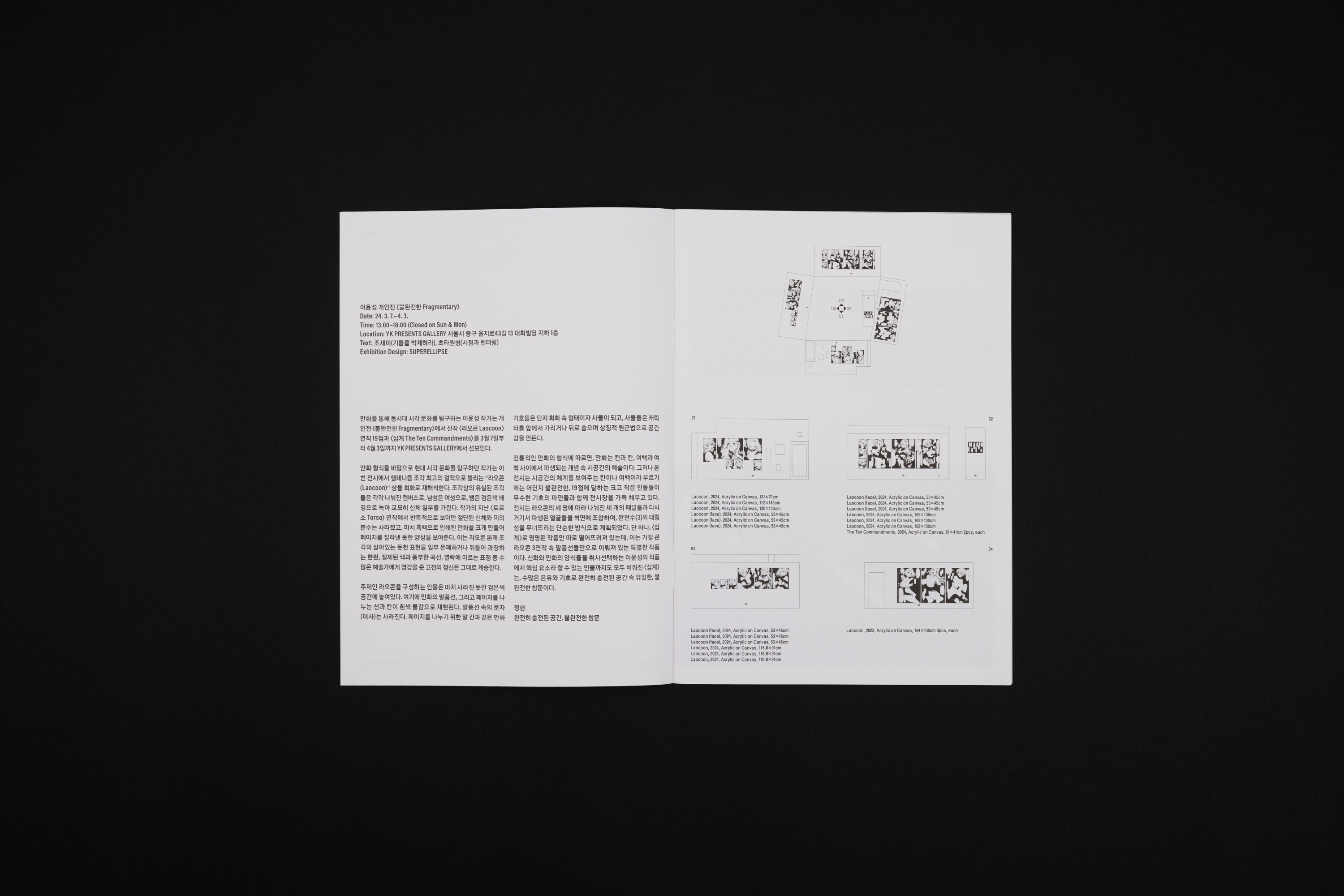
In 불완전한 Fragmentary (YK Presents, Seoul, 2024), the Laocoon triptych (2024, acrylic on canvas, 194 × 130 cm each) was shown at the center, together with three works of the same title at 162 × 130 cm, one each at 131 × 70 cm, 112 × 145 cm and 120 × 100 cm, and nine at 53 × 45 cm.
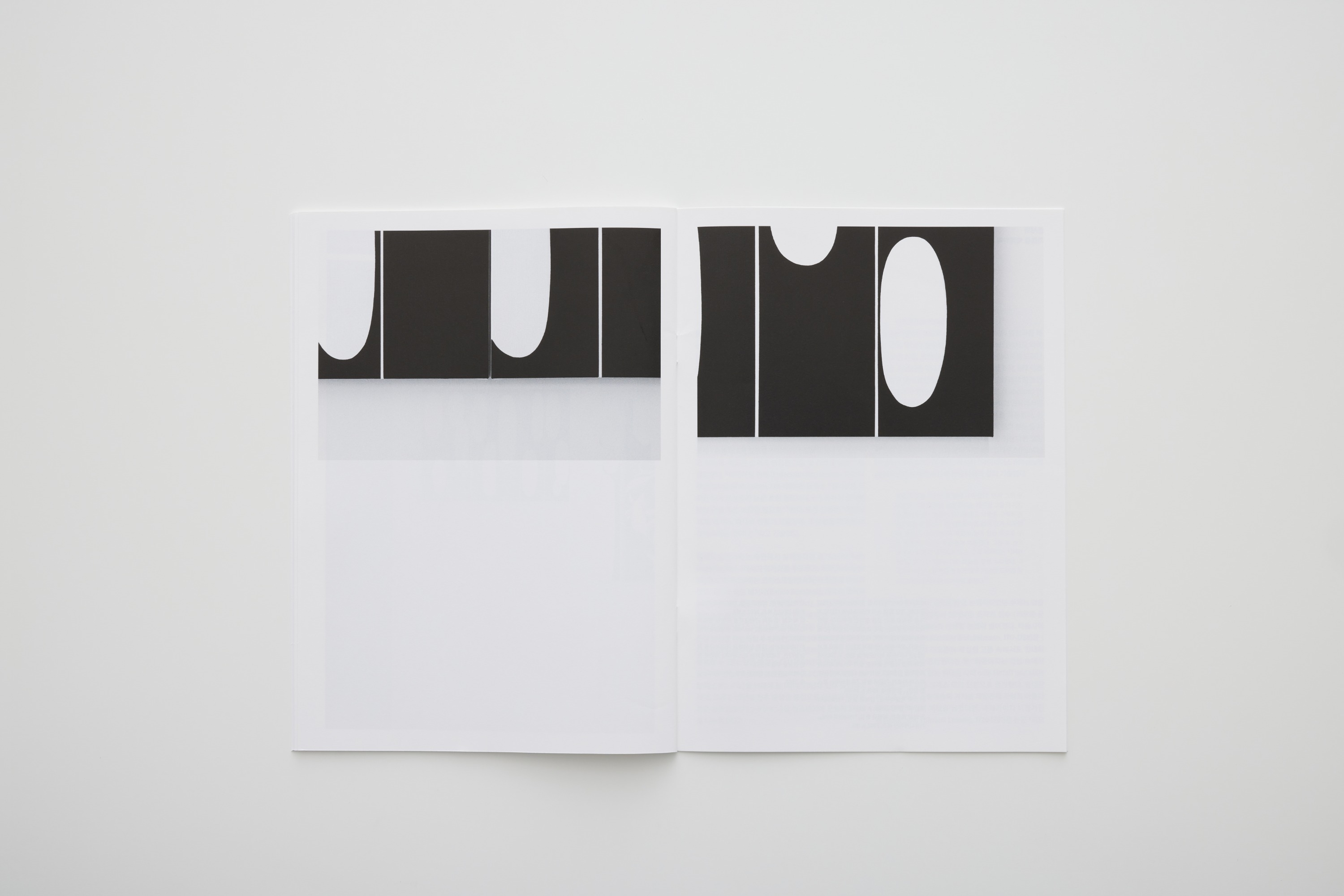
On the columns of the exhibition space hung The Ten Commandments (2024, acrylic on canvas, 61 × 41 cm each, two canvases). The two canvases take the shape of the two stone tablets Moses received, with ten empty speech balloons painted inside them. On the tablets that bear the word of God, nothing is written. Laocoon, screaming unheard toward the gods, and the Ten Commandments, emptied of the words God handed down, remain an incomplete vacuum.
View work →