Head of Medusa (Silver Edition)
30 × 24 × 24 cm
Painted 3D-printed resin
Signed and numbered, edition of 10
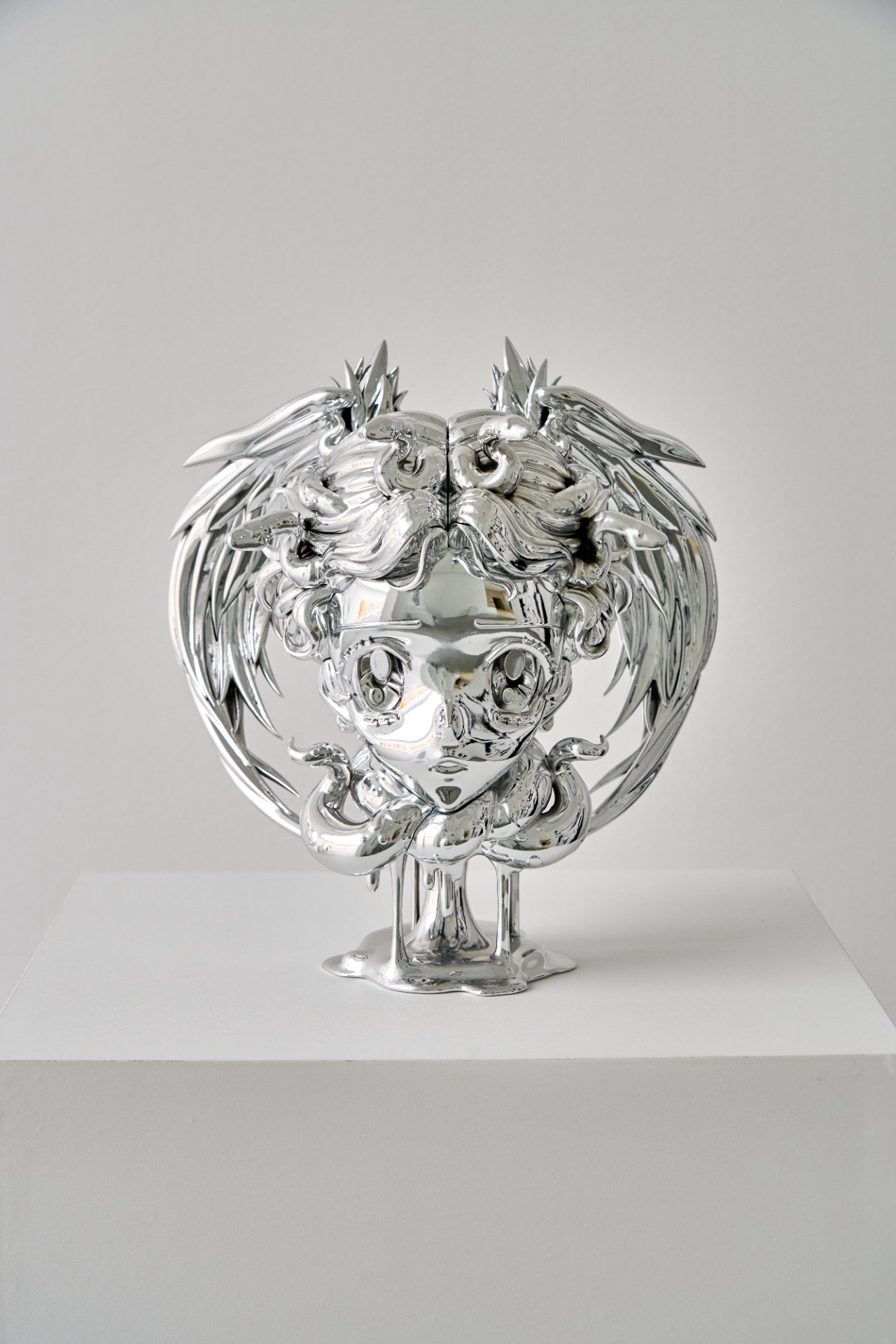
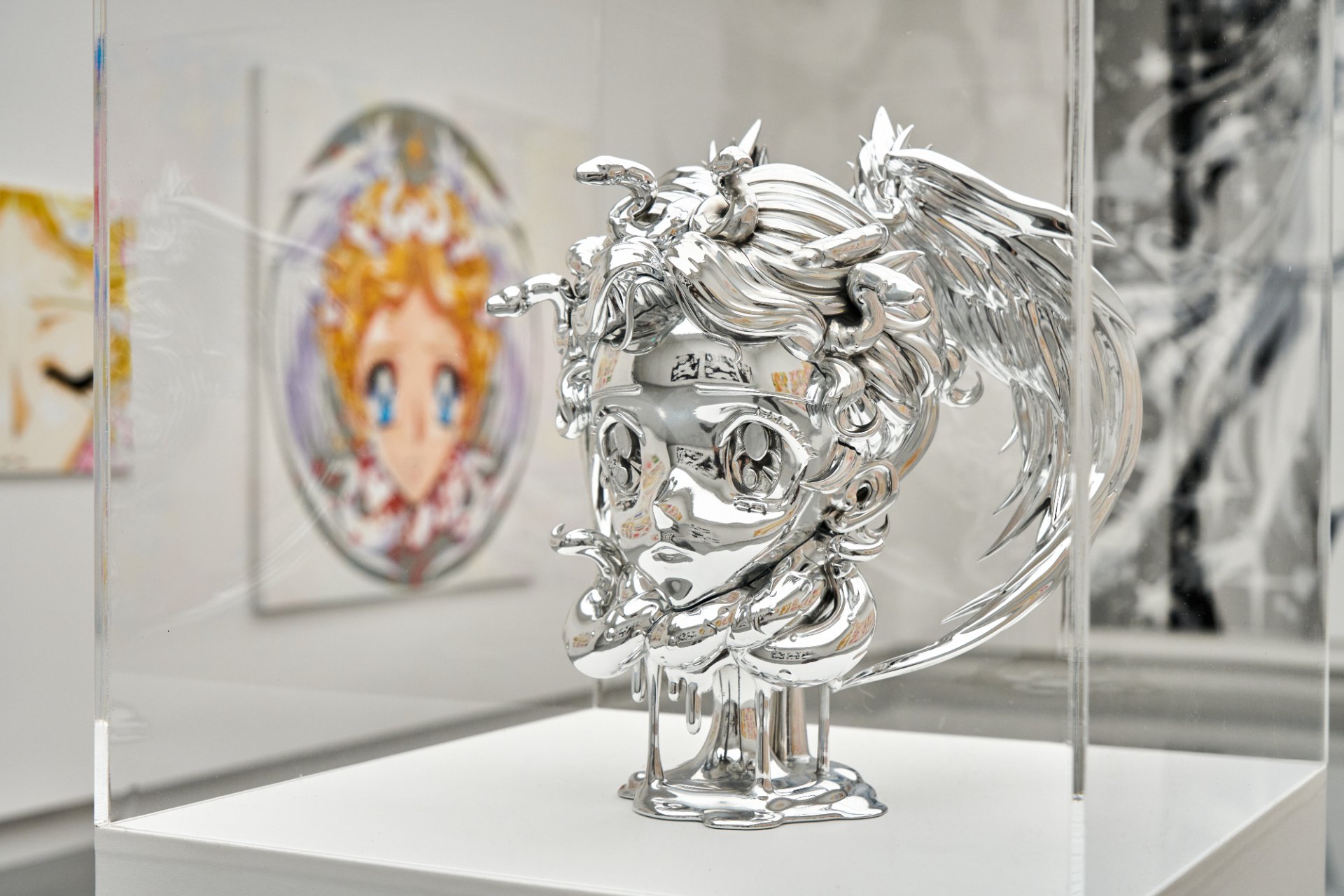
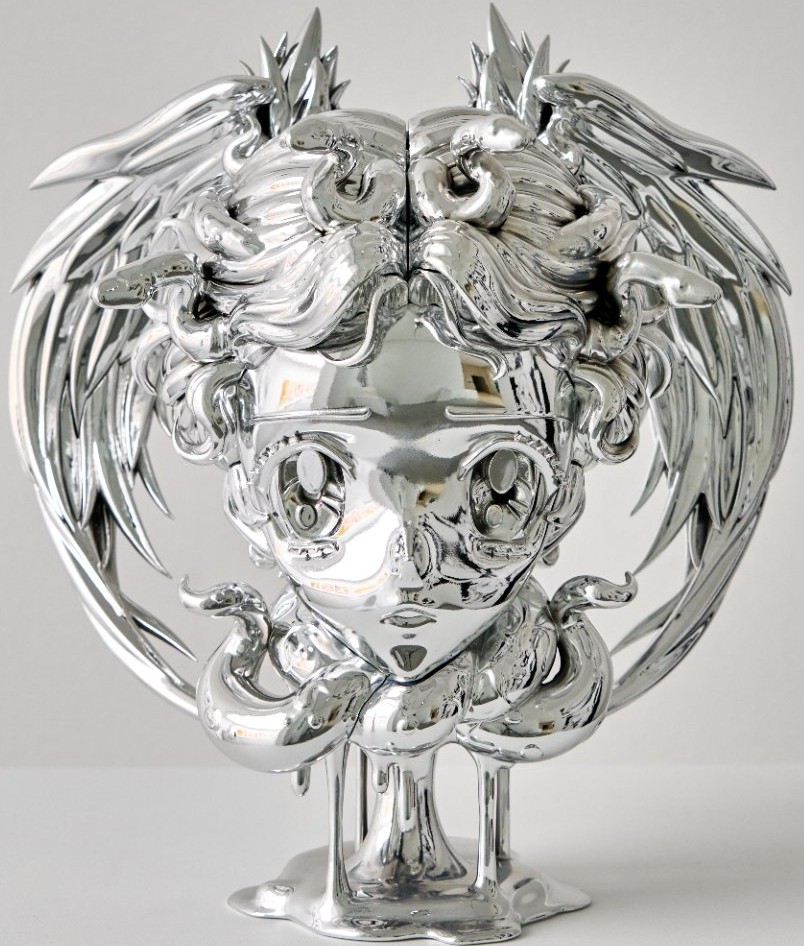
〈Head of Medusa (Silver Edition)〉(2021)은 〈메두사〉 연작에서 회화로 그려 온 메두사의 얼굴을 입체로 옮긴 두상 조각입니다.
스케치를 그리고 3D 프로그램으로 모델링한 뒤 3D 프린터로 출력해 만들었습니다.
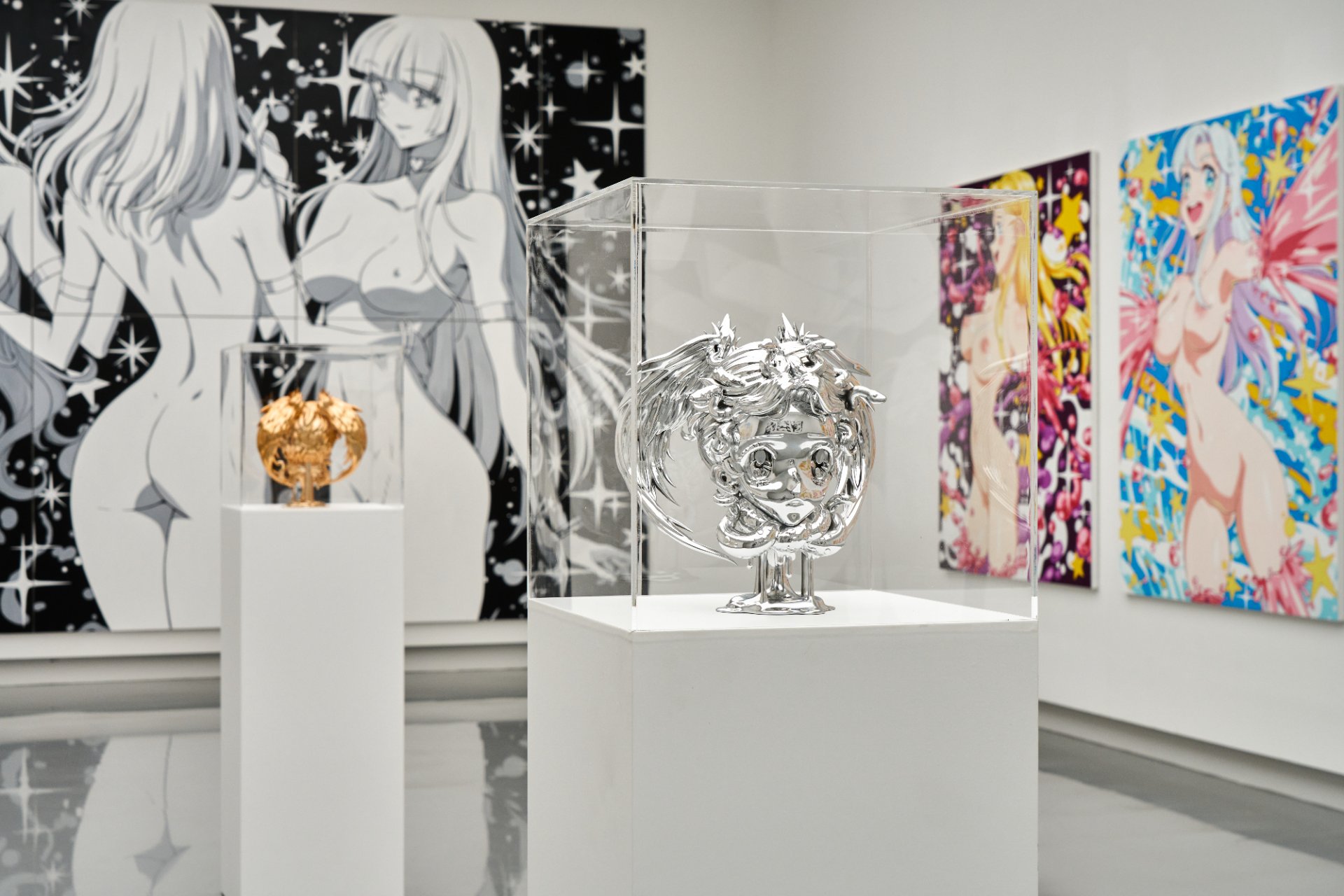
화이트, 골드, 실버의 세 가지 에디션으로 각 10점씩 제작되었으며, 이 작품은 그 가운데 실버 에디션입니다.
Head of Medusa (Silver Edition) (2021) is a sculpted head that carries the face of Medusa, painted throughout the Medusa series, into three dimensions. It was made by drawing a sketch, modeling it in a 3D program, and printing it on a 3D printer. The sculpture was produced in three editions (white, gold, and silver) of ten each; this is the silver edition.
30 cm
24 × 24 cm
30 × 24 × 24 cm
Painted 3D-printed resin
Signed and numbered, edition of 10
원작Original Work

Medusa
Head of Medusa (Silver Edition), 2021, Painted 3D-printed resin, 30 × 24 × 24 cm, edition of 10
〈메두사〉는 그리스 신화의 메두사를 애니메이션의 얼굴로 그린 연작이다. 방패의 장식처럼 은색 원 안에 금발과 뱀, 날개에 둘러싸인 얼굴을 넣었다. 그 얼굴은 여러 색과 표정으로 변주되며 그려졌고, 회화에서 3D 조각으로까지 확장되었다.
두상 조각을 하나 만들고 싶었고, 그에 맞는 주제를 찾다가 메두사의 머리에 이르렀다. 메두사는 머리만 남아서도 힘을 갖는 묘한 존재다. 잘린 머리는 아테나의 방패에 붙어 신의 무기가 되었고, 고대 그리스에서 메두사의 얼굴은 방패와 신전에 새기는 액막이였다. 보면 돌이 된다는 설정은 누구도 그 얼굴을 정면으로 볼 수 없었다는 뜻이고, 페르세우스조차 방패에 비친 상으로만 보았다.
메두사는 본래 아름다운 여인이었고, 아테나의 저주로 머리카락이 뱀이 되었다. 나는 뱀이 된 뒤에도 그녀가 아름다웠을 거라고 생각했다. 그녀를 괴물로 만든 것은 그 얼굴이 아니라, 보지도 않고 판단한 사람들의 소문이었다. 아무 잘못 없이 괴물로 취급되는 일이 지금도 흔하다는 점에서, 이 신화는 현대에도 유의미하다고 보았다. 그래서 나는 메두사를 애니메이션 속 아름다운 얼굴로 그렸다.
카라바조는 〈메두사〉(1597~1598)에서 잘린 머리를 실제 방패 위에 그렸다. 루벤스는 〈메두사의 머리〉(1617~1618)에서 땅에 놓인 머리와 피에서 태어나는 뱀들을 담았고, 베르니니는 〈메두사 흉상〉(1644~1648)에서 머리카락이 뱀으로 변하는 순간의 고통스러운 얼굴을 대리석으로 깎았다. 그 작품들을 참고해, 사각 캔버스 안에 방패를 닮은 은색 원을 두고 그 안에 얼굴을 넣었다. 금발과 장식처럼 배열된 뱀, 날개가 얼굴을 둘러싸고, 잘린 목에서는 붉은 피가 흐른다. 피를 토르소의 분홍이 아니라 붉은색으로 칠한 것은 귀여움보다 짙고 아름다운 쪽을 살리고 싶어서였다.
그림체는 1980~90년대 일본 애니메이션과 게임의 작화를 떠올리며 그렸다. 머리카락 한 올 한 올에 빛이 들고 결이 살아 있는 것이 그 시절 작화의 특징이라고 생각한다. 2000년대 이후의 만화와 애니메이션이 단순하고 귀여워졌다면, 그 이전에는 상대적으로 굵직하고 짙은 느낌이 있었고, 메두사에는 그쪽이 맞는다고 보았다.
그전까지는 같은 캐릭터를 반복해서 그린 적이 거의 없었지만, 메두사는 하나의 이미지를 반복하면서 얻어지는 것을 보기에 맞는 주제라고 생각했다. 〈Head of Medusa〉(2021, 캔버스에 유채, 162×162cm)를 중심으로, 〈Head of Medusa – Gold〉(2022, 80×80cm)와 〈Head of Medusa – Pink〉(2022, 73×91cm), 〈Medusa's Smile〉과 〈Medusa's Wrath〉(2021, 각 80×80cm), 그리고 선으로만 그린 흑백의 〈Head of Medusa – Black and White〉(2021, 73×73cm)로 같은 얼굴을 변주해 나갔다. 이 작품들은 《Nu Collection》(유아트스페이스, 서울, 2021)에서 처음 선보였고, 《Odd&Nu》(뮤지엄 웨이브, 서울, 2024)로 이어졌다.
처음의 목적대로 조각도 만들었다. 스케치를 그리고 3D 프로그램으로 모델링한 뒤 3D 프린터로 출력한 것이 〈Head of Medusa〉(2021, 레진, 24×24×30cm)다. 화이트, 골드, 실버의 세 가지 에디션으로 각 10점씩 만들었다. 작업하는 과정에서 많은 것이 변했고, 원본이라는 개념은 희미해졌다. 가상의 3D 이미지는 아무리 확대해도 끝이 없을 만큼 날카롭지만, 실물로 나온 조각은 그보다 열화된다. 그런데도 실물이 주는 존재감이 다르다는 것을 작품이 완성되는 순간 느낄 수 있었다.
Medusa is a series that paints the Medusa of Greek myth with the face of an anime character. Like the emblem on a shield, the face sits inside a silver circle, framed by blond hair, snakes, and wings. That face has been painted in variations of color and expression, and has expanded from painting even into 3D sculpture.
I wanted to make a sculpted head, and in searching for a subject to suit it, I arrived at the head of Medusa. Medusa is a strange being who keeps her power even when only her head remains. Her severed head was set on Athena's shield and became a weapon of the gods, and in ancient Greece Medusa's face was an apotropaic image carved on shields and temples. The premise that anyone who looks at her turns to stone means that no one could ever look at that face directly; even Perseus saw it only as a reflection in his shield.
Medusa was originally a beautiful woman, and Athena's curse turned her hair into snakes. I thought she must have remained beautiful even after her hair became snakes. What made her a monster was not her face but the rumors of people who judged her without ever looking at her. Because being treated as a monster through no fault of one's own is still common today, I felt this myth still speaks to the present. So I painted Medusa with the beautiful face of an anime character.
Caravaggio painted the severed head on an actual shield in Medusa (1597–1598). Rubens showed the head lying on the ground, with snakes being born from its blood, in Head of Medusa (1617–1618), and Bernini carved in marble the anguished face at the moment her hair turns to snakes in Bust of Medusa (1644–1648). With those works in mind, I placed a silver circle resembling a shield inside a square canvas and set the face within it. Blond hair, ornamentally arranged snakes, and wings surround the face, and red blood flows from the severed neck. I painted the blood red rather than the pink of Torso because I wanted to bring out something deep and beautiful rather than cute.
The drawing style recalls Japanese animation and game art of the 1980s and '90s. I think the mark of that period is that every single strand of hair catches the light and keeps its texture. If manga and anime since the 2000s have become simpler and cuter, what came before had a comparatively bolder, denser feel, and I felt that suited Medusa.
Until then I had almost never painted the same character over and over, but Medusa seemed the right subject for seeing what is gained by repeating a single image. Around Head of Medusa (2021, oil on canvas, 162 × 162 cm), I developed the same face through variations: Head of Medusa – Gold (2022, 80 × 80 cm) and Head of Medusa – Pink (2022, 73 × 91 cm); Medusa's Smile and Medusa's Wrath (2021, 80 × 80 cm each); and Head of Medusa – Black and White (2021, 73 × 73 cm), drawn in line alone. The works were first shown in Nu Collection (UARTSPACE, Seoul, 2021) and continued in Odd&Nu (MUSEUM WAVE, Seoul, 2024).
As I had first intended, I also made the sculpture. Head of Medusa (2021, resin, 24 × 24 × 30 cm) was made by drawing a sketch, modeling it in a 3D program, and printing it on a 3D printer. It was produced in three editions, white, gold, and silver, of ten each. Much changed in the course of the work, and the notion of an original grew faint. A virtual 3D image stays sharp however far it is enlarged, seemingly without end, while the sculpture that emerges as a physical object is degraded by comparison. And yet, the moment the work was finished, I could feel that the presence of the physical object was something else entirely.