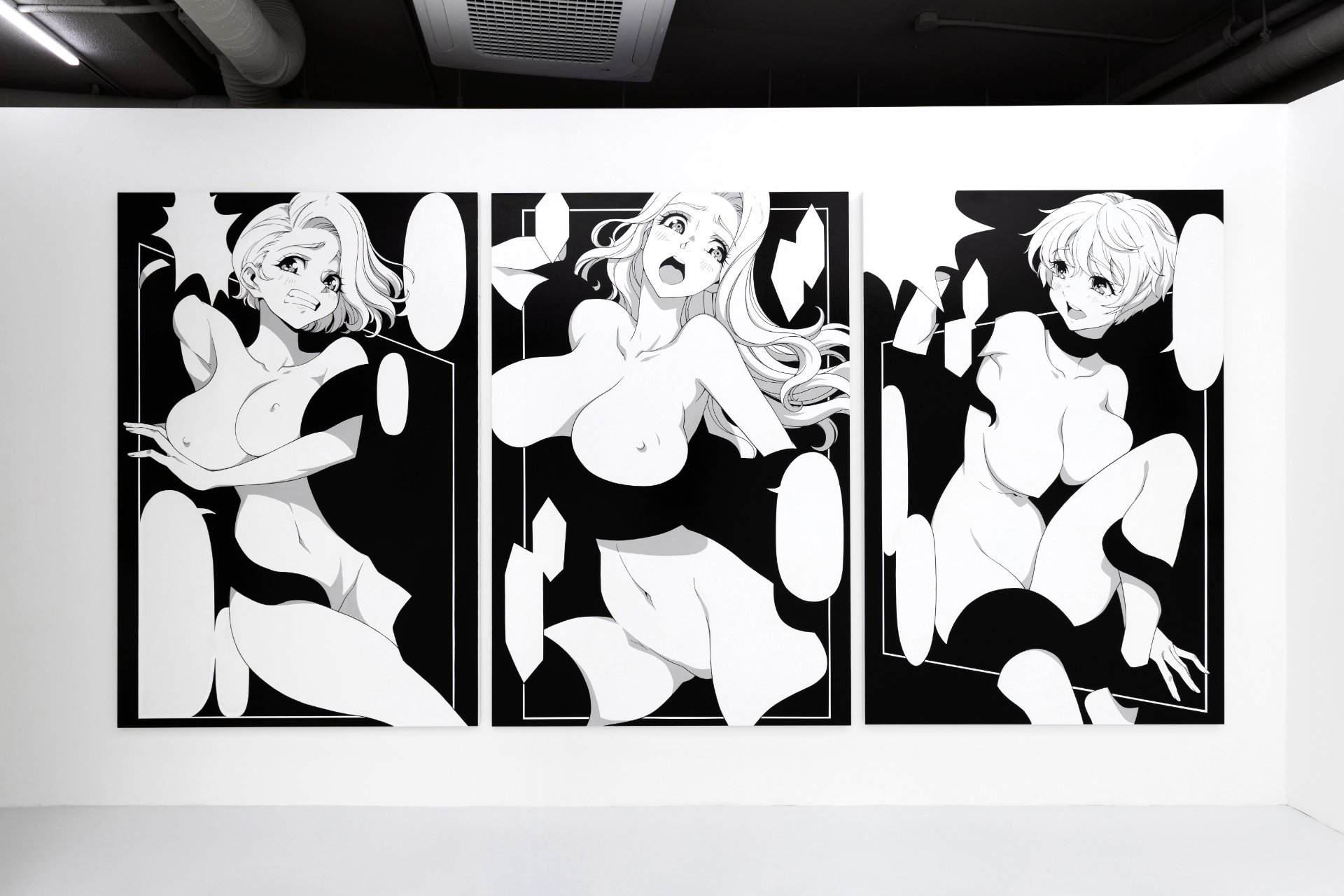
Prometheus and The Three Graces
Prometheus and The Three Graces return, on a large scale, to two myths first taken up in the Pixel Prometheus The Three Graces series. The gold-ground Prometheus enlarges its pixels to fill a canvas more than three meters tall, while the black-and-white Three Graces leaves pixels behind and is painted in line and plane.
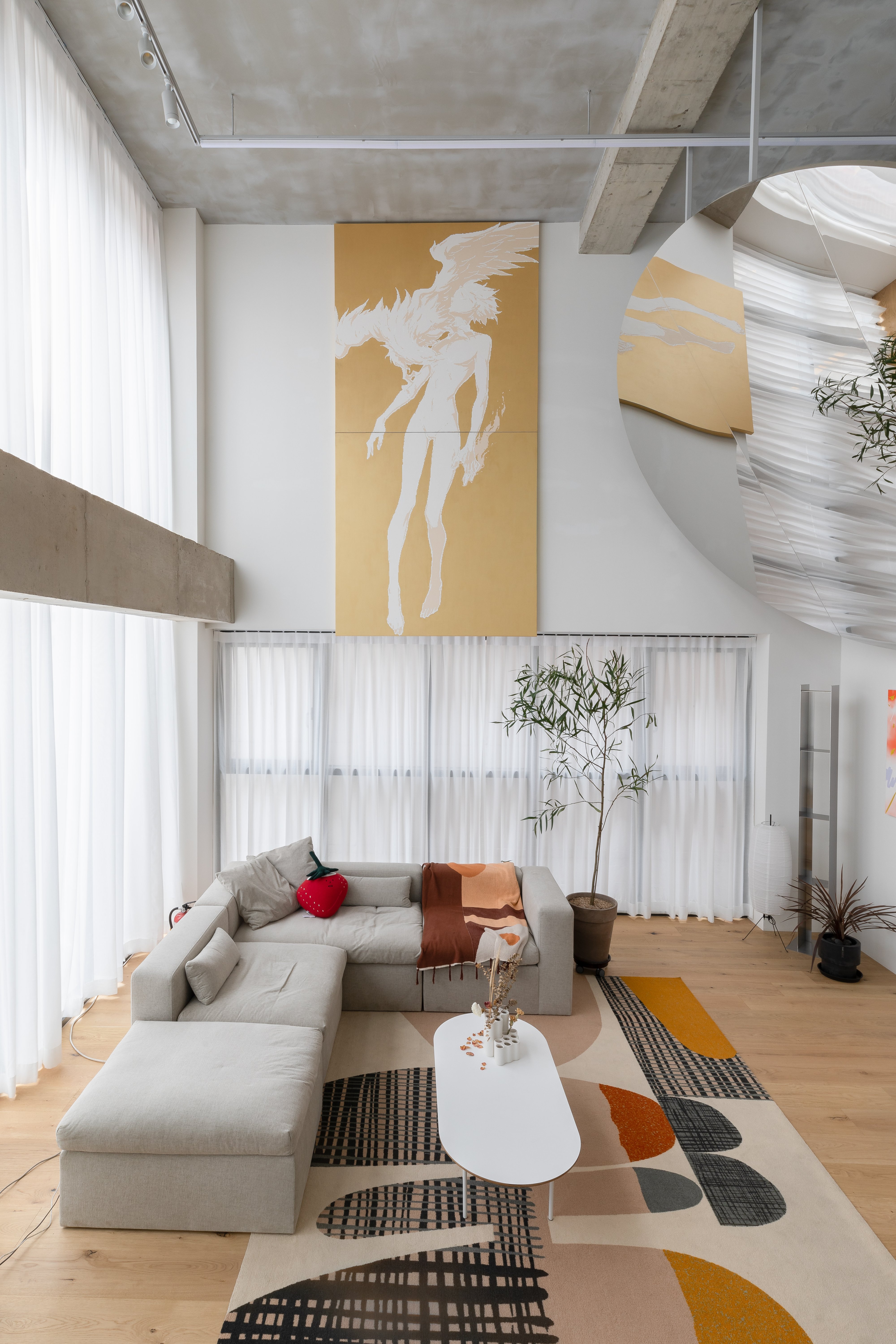
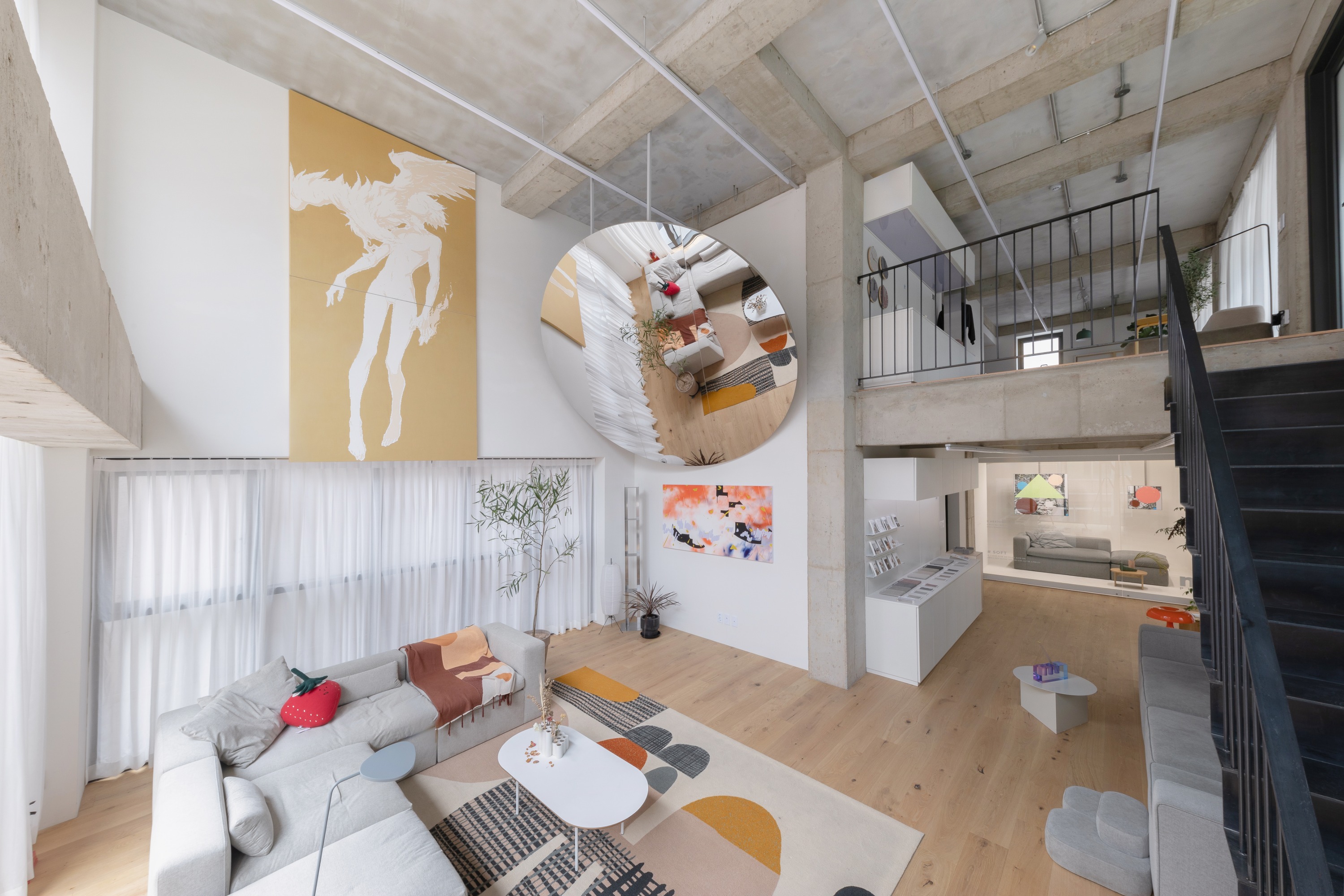
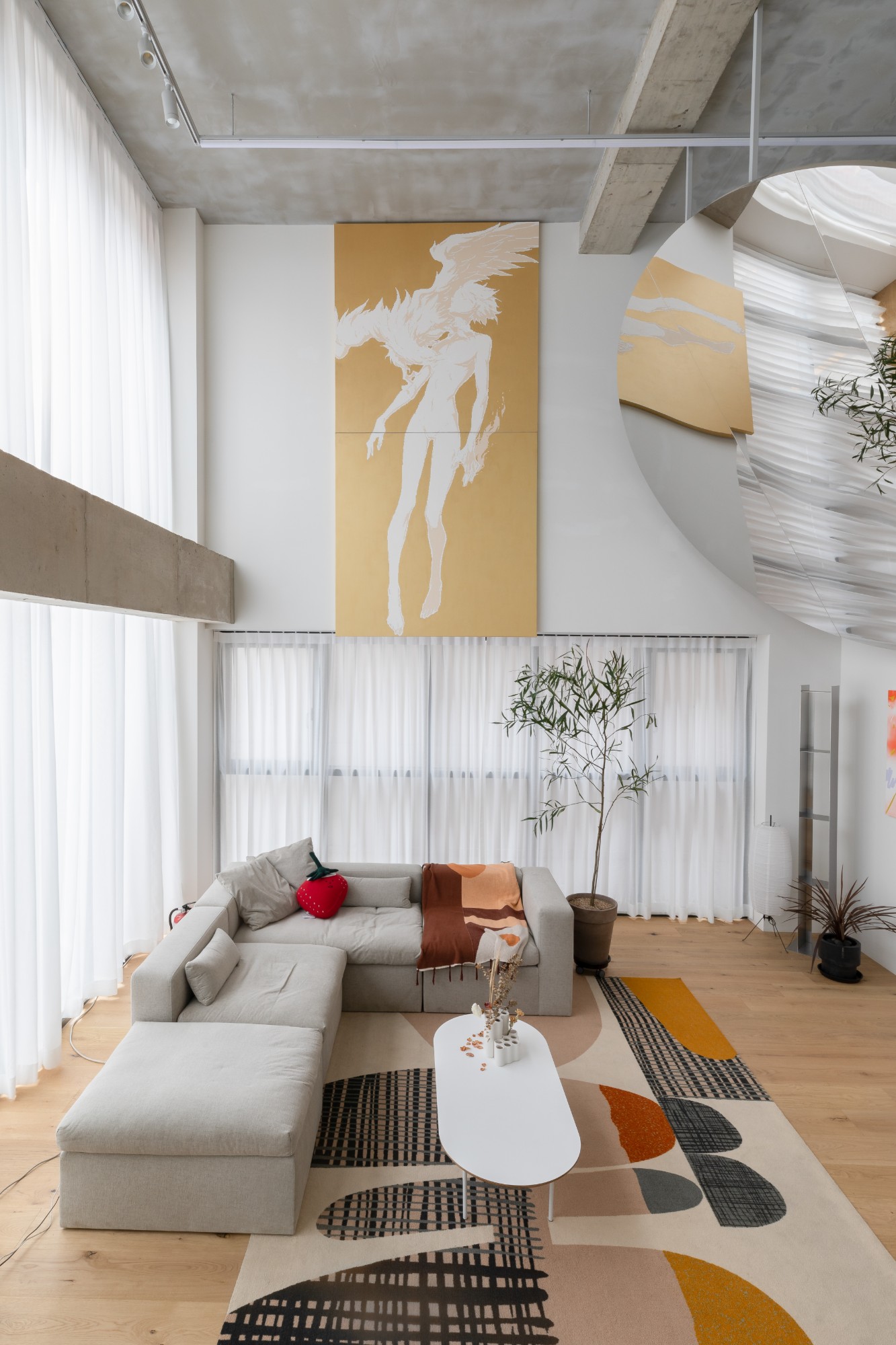
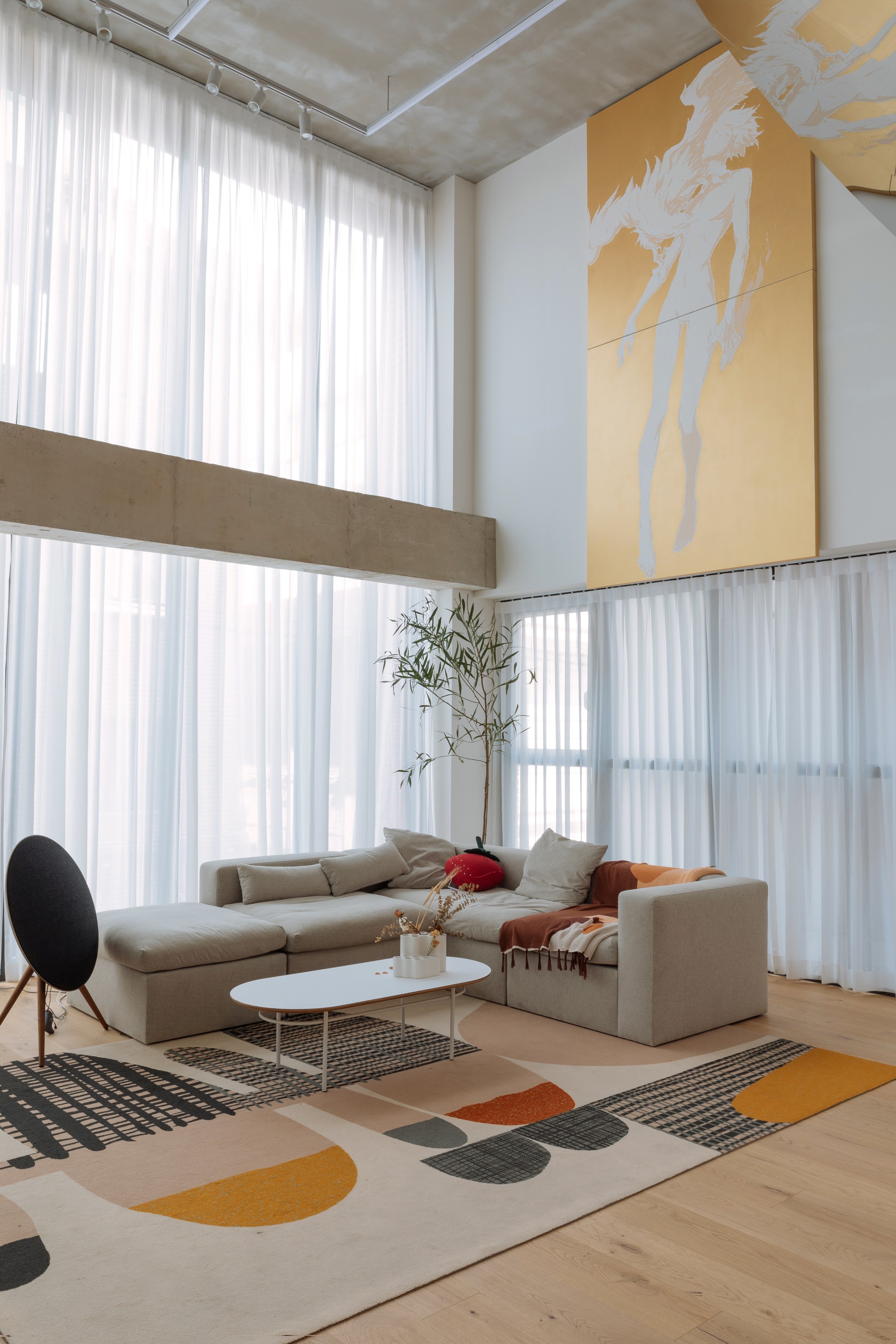
Prometheus (2020, oil on canvas, 2 panels, 320 × 160 cm overall) is painted on two canvases joined vertically. On a gold ground, a young, white-bodied Prometheus rendered in pixels hangs in the air. An eagle clings to his back with its wings spread, pecking at his liver, and in one hand burns the fire he stole from the gods. It is a scene of punishment, yet the body is not crushed by pain; it seems to soar into the light, as if transfigured.
The figure is built only from white pixels and pixels of gold mixed with a great deal of white: up close it is a field of square planes, and from a distance it looks like a silhouette cut out and laid on the gold. Like the gold leaf of medieval icons, the gold ground calls to mind something beyond this world, and it shifts color moment by moment with the light that falls on it: a sacred ground, changed by light, for the one who gave the gods' fire to humankind.
The work was shown in Gradation: From Red to Golden (MUNITO + Superellipse Gallery, Seoul, 2020). It was the second exhibition of Superellipse Gallery, a gallery project without a physical space organized by Superellipse, and a continuation of the 2019 series of solo exhibitions at STANDARD.a. Five painters took part over six months in the Yeonnam showroom of the furniture brand MUNITO, and the exhibition was planned by imagining the collector's room where a painting finally comes to rest. Prometheus hung high in the showroom's double-height living space, above a sofa and curtains, in a light that would change from morning to evening and with the seasons.
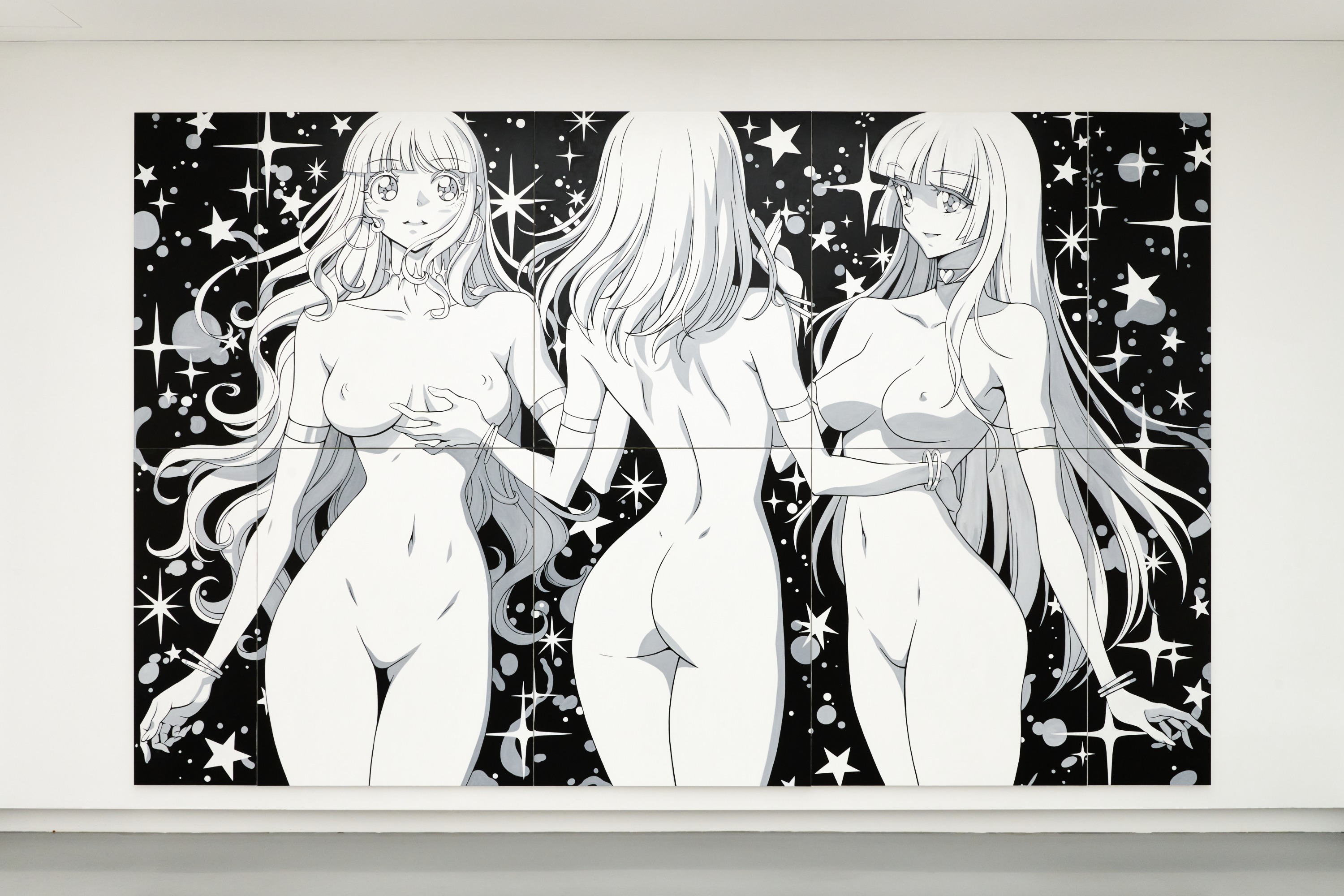
The Three Graces (2022, oil on canvas, 10 panels, 300 × 480 cm overall) depicts the Three Graces as three bishōjo across ten joined canvases. The central figure turns her back while the two at either side face forward, following the classical composition handed down from Roman sculpture and wall painting to Raphael's Three Graces (1504–1505). This composition shows one body from three directions at once, front, back, and front again. Much as I once divided Danae into three figures, it is a way of looking at a timeless ideal of beauty from several sides. Against a black night sky scattered with starlight, the three rest their hands on one another's shoulders and bodies.
The palette is limited to white, black, and the grays between them. Where the 2019 Three Graces Pixel Props lifted the eyes, hair, and parts of the bodies of the bishōjo Graces as fragments in the same black-and-white pixels, this painting spreads the three whole figures across a single large picture. Some images are more beautiful in black and white. Once color was taken away, the three bodies stood out clearly in line and plane, light and dark alone.
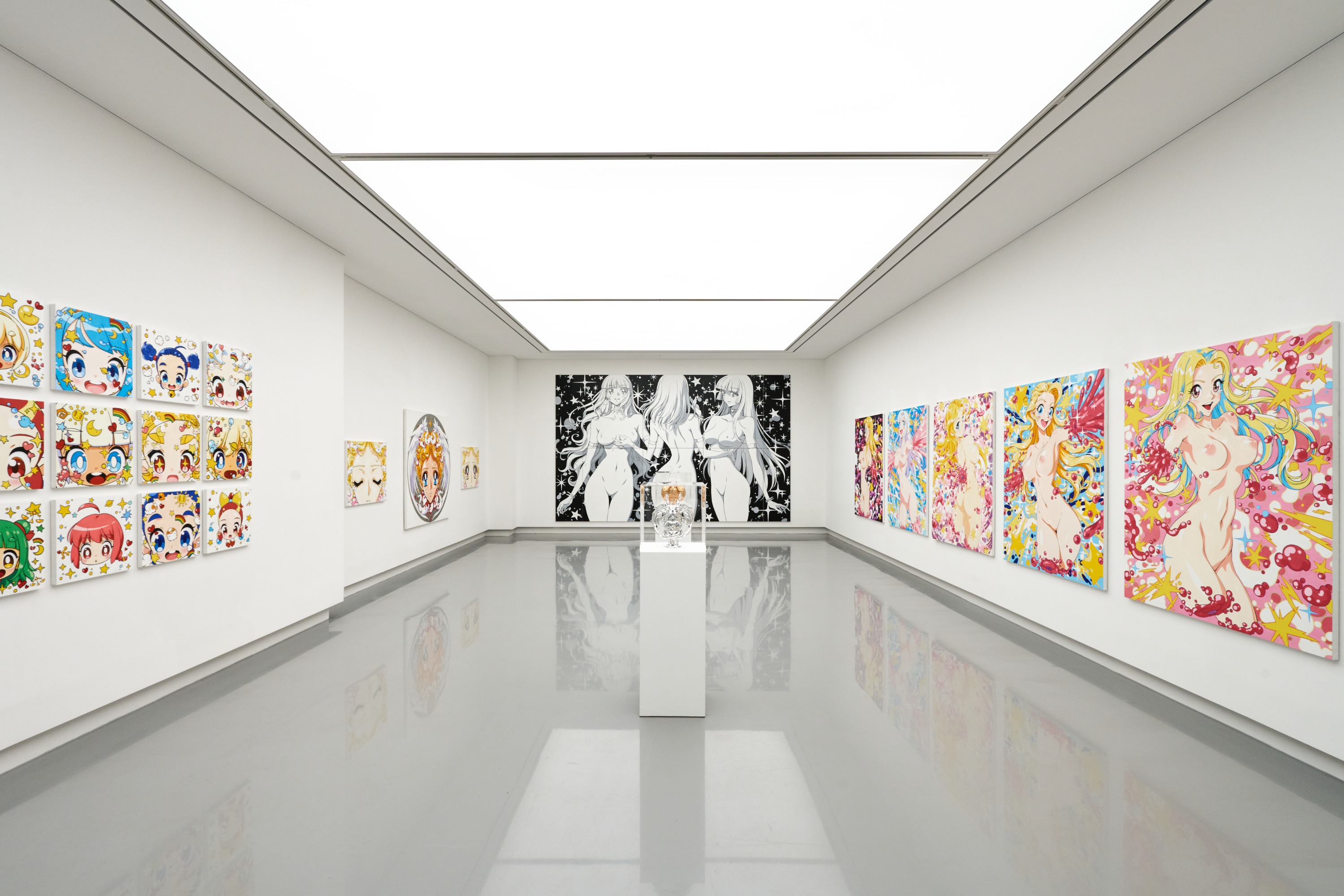
In Odd&Nu (MUSEUM WAVE, Seoul, 2024), The Three Graces hung on the far wall of the gallery, with the Torso series along the right wall and the SD Zodiac and Medusa series along the left.